

Spain has become one of the most active fulfillment markets in Europe, and international brands are paying attention. Online retail in the country topped €95 billion in 2024, up 13.1%, and a single quarter, Q3 2025, reached €29,296 million, a 19.3% year-on-year rise, according to Spain’s CNMC. Domestic trade is growing even faster: operations within Spain rose 29.8% to €9,300 million in the same quarter, a sign that the home market is maturing, not just the cross-border one. This guide breaks down what fulfillment actually costs in Spain, what drives those costs, who the main providers are, where to locate, and what foreign companies need to start.
How much does fulfillment cost in Spain?
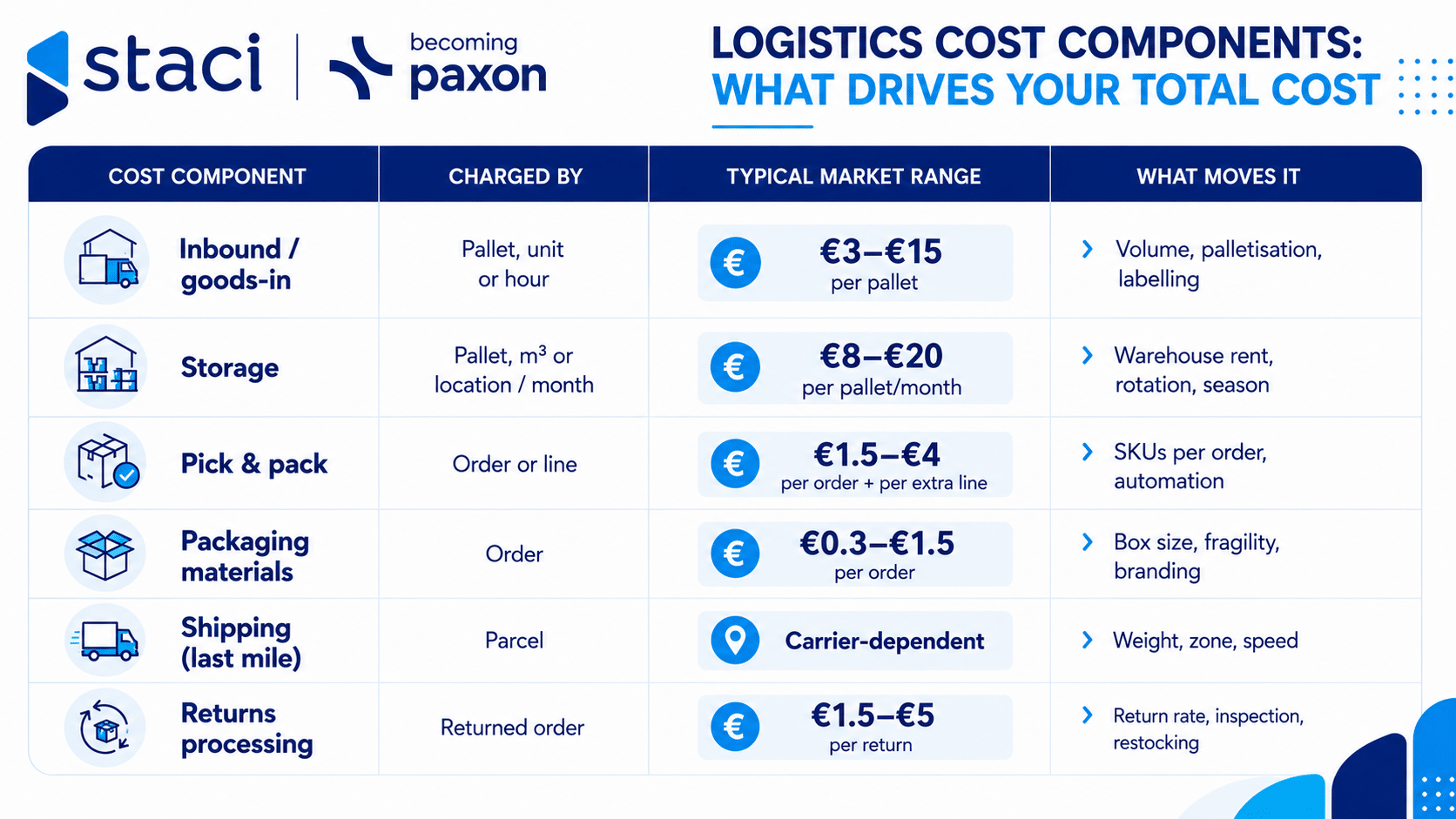
Fulfillment in Spain is not a single price. It is the sum of inbound handling, storage, pick & pack, packaging materials, shipping, and returns processing. Two brands shipping the same volume can pay very different totals depending on inventory rotation, order profile, and location.
The clearest way to read a quote is to separate the fixed structural cost (storage, tied to warehouse rent) from the variable per-order cost (pick & pack, materials, shipping). Storage is the line most exposed to the Spanish property market. Pick & pack and shipping scale with volume.
The table below shows the typical cost components. The storage range reflects published logistics rents; the per-order ranges are typical market figures and should be modelled against your own rotation, not read as a fixed tariff.
The structural driver underneath storage is warehouse rent, and Spanish rents have climbed. Logistics headline rents in Spain grew around 10% in 2024, well above the EMEA average, according to Cushman & Wakefield. By the close of 2025, prime rent in Madrid stood at €7.25/m²/month, per CBRE. One offset works in Spain’s favour: Cushman & Wakefield notes the country has more competitive labour and electricity costs than most peer European markets, which keeps operating costs in check even as rents rise.
A simple worked example shows how the components combine. A brand shipping 2,000 orders a month, holding 30 pallets of stock with one item per order, might see roughly €300–€600 in storage, €3,000–€8,000 in pick & pack, plus materials, shipping and returns on top. The same brand at 6,000 orders a month spreads its fixed storage and technology fees over three times the volume, so the cost per order falls even though the monthly bill rises. The figures are illustrative, not a quote, but the mechanism is the point: volume and rotation, not the headline pick rate, decide your real cost.
This is also why two quotes are hard to compare at face value. A provider with a low pick rate but a high monthly storage charge per pallet can cost more in total than one with a slightly higher pick rate and efficient slotting. The only reliable comparison models storage cost per order using your own inventory rotation, not the example scenario in the provider’s rate card. Brands that skip this step often switch operators within six months because the total never matched the quote.
For a line-by-line breakdown of where the money goes in a single order, see Staci’s companion analysis, Fulfillment solutions: cuánto cuesta de verdad cada pedido.
What makes fulfillment in Spain cheaper or more expensive?
The biggest swing factor is order volume. Technology fees, minimum storage charges, and goods-in costs are largely fixed, so as orders rise, the cost per order falls, up to the point where a warehouse hits capacity. Below that point, low volume means fixed costs are spread thin and the per-order cost looks high.
Four other variables move the total:
- Inventory rotation. Slow-moving stock sits longer and accrues more storage cost. Fast rotation lowers the storage cost embedded in each order.
- Return rate. Online returns in Europe commonly run between 25% and 40%, according to Mordor Intelligence far above in-store levels, and premium apparel can reach 37.5%. Each return carries inbound, inspection, and restocking cost.
- Location and land scarcity. Prime space is tight. In Barcelona’s ZAL, vacancy sits at around 1.3%, which keeps rents, and therefore storage costs, high, according to Cushman & Wakefield.
- Delivery-speed expectations. In the 2025 Third-Party Logistics Study by NTT DATA, Penske and Penn State, 48% of shippers said customers routinely expect delivery in under two days. Faster promises raise carrier and network cost.
The fulfillment market in Spain: size and momentum
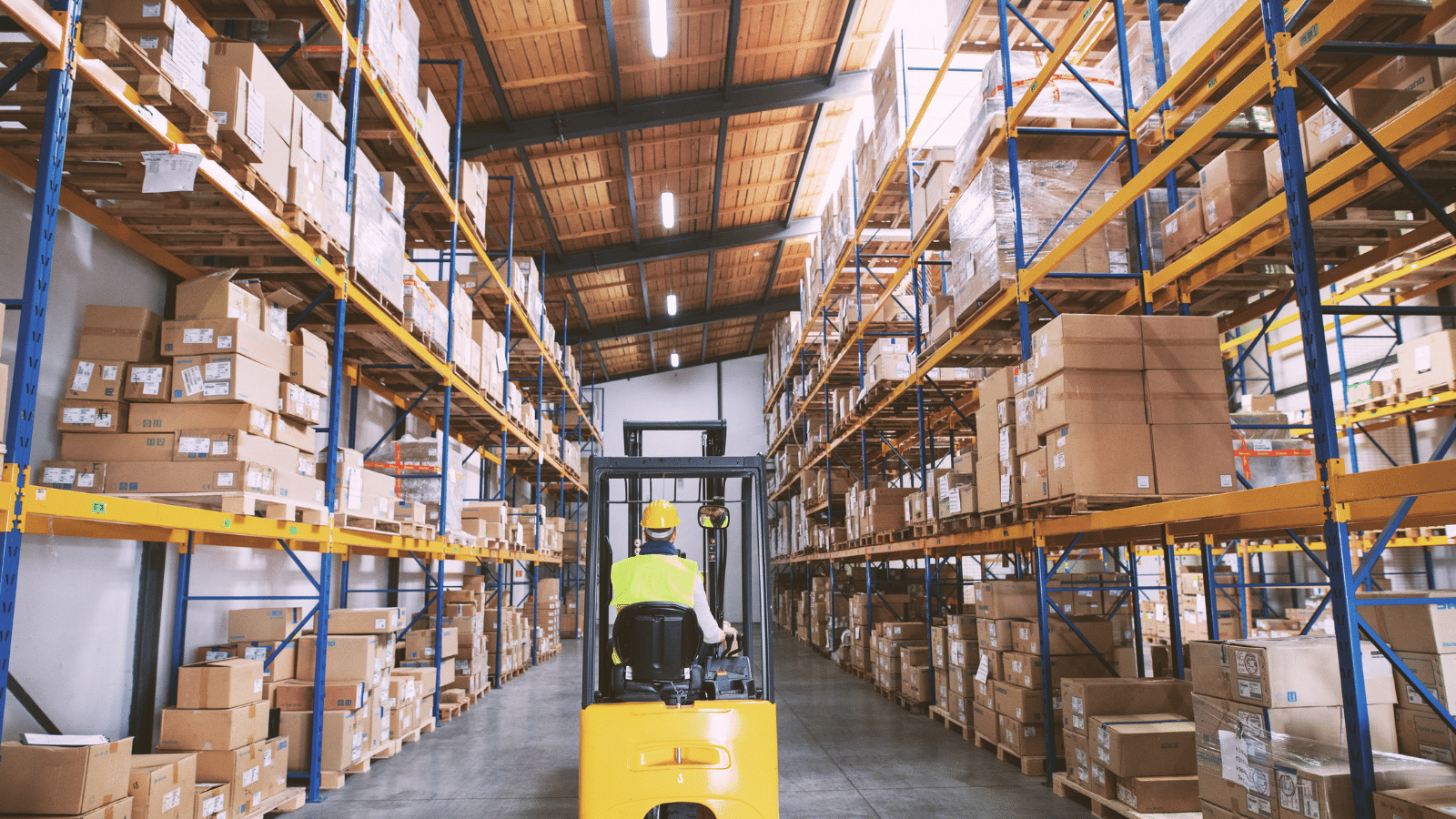
Spain’s logistics real estate market is expanding, which matters to anyone outsourcing fulfillment: more modern space and more competition among operators. Investment in the industrial and logistics sector reached €1.3 billion in 2025, according to CBRE, with Barcelona and Madrid accounting for nearly 70% of the volume.
Take-up confirms the demand. The Central (Madrid) region exceeded one million m² of absorption in 2025, while Catalonia contracted 615,000 m². Momentum carried into 2026: Madrid passed 310,000 m² and Barcelona 235,000 m² of take-up in Q1 2026, with prime rents hitting new highs, per Cushman & Wakefield.
Outsourcing pays off when the partner is the right one. In the same NTT DATA study, 82% of shippers said 3PLs improved customer service and 66% said they reduced overall logistics costs, though 89% rating their relationships «successful» shows the result depends on partner fit, not on outsourcing alone.
Technology is now a deciding factor in that fit, and it feeds back into cost. In the NTT DATA study, 68% of shippers requested control-tower visibility, up from 49% the year before, and 61% said change-management capability was essential to adopting new technology. For a brand, this means a modern provider’s visibility and automation are not extras: they reduce errors, cut returns, and lower the cost per order over time. A cheaper operator without these tools can end up more expensive once mistakes and manual handling are counted.
Who are the main fulfillment providers in Spain?
The Spanish market splits into clear specialties. Choosing well means matching your product and order profile to the right type of operator rather than to the biggest name. The providers below are grouped by what they are known for.
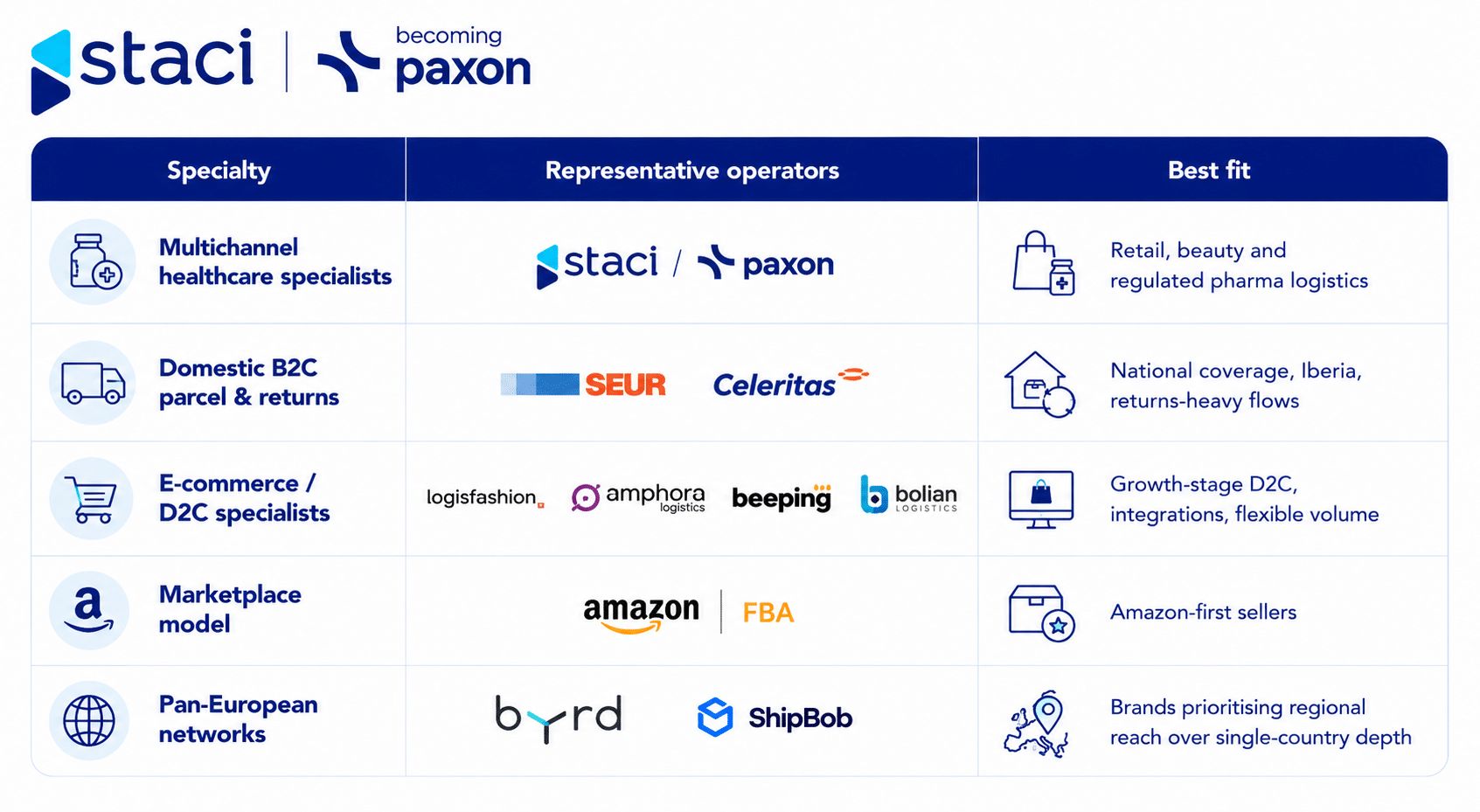
A few distinctions are worth keeping in mind. Global integrators such as DHL Supply Chain, UPS and FedEx Logistics bundle warehousing with their own transport networks and serve many sectors at scale. Domestic parcel and returns specialists like SEUR and Celeritas focus on B2C delivery across Spain and Portugal. E-commerce specialists including Logisfashion (fashion), Amphora Logistics, Beeping and Bolian Logistics target D2C brands with platform integrations and flexible volume tiers. Amazon FBA suits sellers whose demand is concentrated on the marketplace. Pan-European networks such as byrd and ShipBob prioritise regional coverage over single-country operational depth.
For regulated pharma and healthcare, requirements differ sharply: GDP-certified facilities, temperature control, and FEFO stock rotation. Staci covers this segment in Fulfillment Farma en Madrid. And if your stock originates in Asia, the operator’s import readiness becomes decisive, covered in Fulfillment center en España para importadores de China y mercados asiáticos.
Beyond specialty, four questions separate a partner from a vendor: Does the provider give live inventory and order visibility, or only status emails? What is the onboarding timeline and who owns it? How are peak-season surcharges and minimums structured? And can the operator scale with you without forcing a costly mid-contract migration? The right answers matter more than the lowest headline rate, because the true cost of fulfillment surfaces in returns, errors and peak handling, not in the pick fee alone.
What is the best location for a fulfillment center in Spain?
The best location depends on your customer base and import flow, but two hubs dominate. Madrid offers central national reach; Barcelona adds Mediterranean access, a major port, and cross-border flows to France and the rest of the EU; Cost and availability vary by hub. At the end of 2025, prime rent was €7.25/m²/month in Madrid and €6.06/m²/month on average in Barcelona, per CBRE and Cushman & Wakefield.
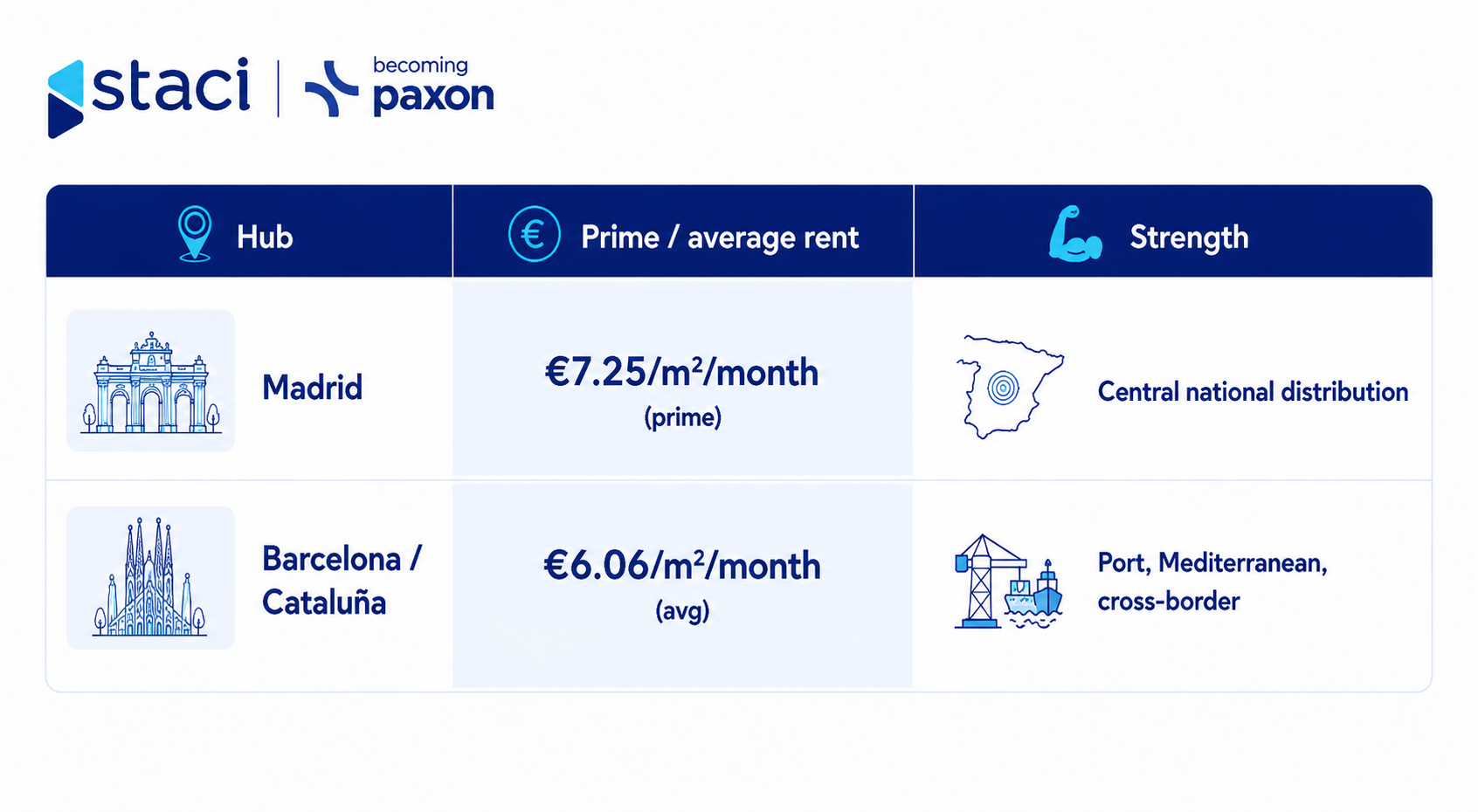
For brands serving the whole country, a central Madrid-area platform plus a Catalan node is a common pattern. Staci operates fulfillment platforms in northeast Spain and in Alcalá de Henares (Madrid), covering both poles. Barcelona’s role as a southern-Europe gateway is examined in Cross docking en Barcelona.
Availability shapes the decision as much as price. Tight vacancy in prime Barcelona and a pipeline of 730,000 m² under construction in the Central region for 2026, per CBRE, mean modern space is contested and rents stay firm. There is also a trade-off between national distribution and last-mile speed: a single central hub minimises storage duplication, while a second node closer to dense urban demand cuts delivery time and last-mile cost. Which wins depends on whether your customers expect next-day delivery or accept a standard two-to-three-day window.
Can foreign companies store and sell products in Spain?
Yes. Foreign companies can store and sell products in Spain, and many do. The key obligation is tax registration: storing stock in a Spanish warehouse, including one rented from a 3PL, creates a taxable presence and triggers Spanish VAT (IVA) registration. Spain applies a zero registration threshold for non-resident businesses, so the obligation begins with the first taxable activity, not after a sales level.
The path differs by origin. EU-based companies can register for Spanish VAT directly. Non-EU companies must appoint a Spanish fiscal representative, unless a tax-cooperation agreement applies. Both need an EORI number to move goods across the EU customs border, mandatory for customs clearance per the European Commission. Operators not established in the EU must still register for customs activities in the Member State of their first operation.
VAT does not always mean a separate filing burden in every market. Selling to consumers across the EU, a brand can use the One-Stop Shop (OSS) to declare cross-border B2C sales through a single return once it passes the EU-wide €10,000 threshold, rather than registering in each country. But OSS does not remove the Spanish registration that storing stock here creates; the two are separate obligations. For B2B sales to Spanish VAT-registered companies, the reverse-charge mechanism usually shifts the VAT accounting to the buyer, so the obligations depend on whether you sell to consumers, businesses, or both, and on where your stock sits.
What documents do you need to start fulfillment in Spain?
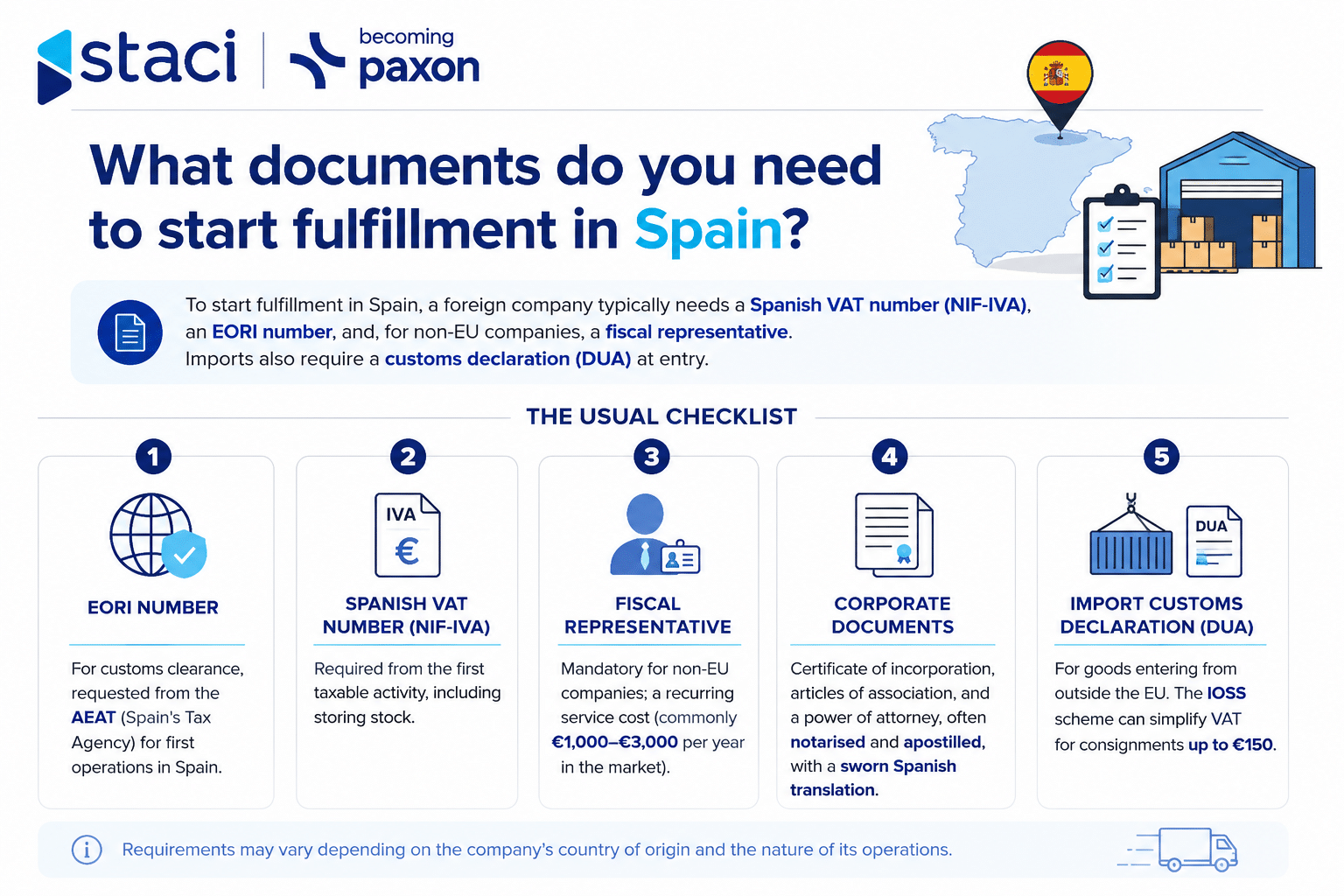
The paperwork follows a clear sequence. You will need an EORI number for customs clearance, requested from the AEAT, Spain’s Tax Agency, for your first operations in the country. You also need a Spanish VAT number (NIF-IVA), required from the first taxable activity, which includes storing stock. Non-EU companies must additionally appoint a fiscal representative, a recurring service that commonly runs €1,000–€3,000 per year. On the corporate side, expect to provide your certificate of incorporation, articles of association and a power of attorney, often notarised and apostilled and accompanied by a sworn Spanish translation. Finally, goods entering from outside the EU need an import customs declaration (DUA), and the IOSS scheme can simplify VAT on consignments up to €150.
VAT registration usually takes a few weeks once documents are in order, so register before shipping stock to avoid clearance and import-VAT delays.
Sequencing matters for cash flow as well as compliance. Importers pay VAT at the border, and a correctly registered company can reclaim that import VAT through its Spanish returns, so getting the NIF-IVA and EORI in place before the first shipment avoids both clearance hold-ups and blocked reclaims. Spain does not allow the «global» or limited fiscal-representation VAT numbers used in some EU countries, which is one more reason to confirm the exact registration path with your fiscal representative or customs agent before stock leaves origin.
Can I integrate Shopify with a Spanish fulfillment provider, and do they handle returns?
Yes on both counts. Most modern Spanish fulfillment providers integrate with Shopify, WooCommerce and major marketplaces through their warehouse management system, synchronising orders, inventory and tracking automatically. Staci’s proprietary platform, E-CATS, gives brands marketplace-builder functionality with client-side control over products, pricing and promotions, and is ISO 27001 certified.
Returns management is part of standard scope for most operators, and it is not a minor line. With European online return rates in the 25%–40% range, reverse logistics, inspection and restocking directly affect your cost per order. Confirm how a provider charges for returns before signing, since flat per-return fees and per-step charges produce very different totals.
The way to control returns cost is to model it like any other line. A flat receiving fee looks simple but hides the real work: inspection, repackaging, restocking, and disposal of unsellable items each carry cost. For categories with high return rates, such as apparel and footwear, returns can quietly become one of the largest items in the fulfillment bill. Providers that automate the returns portal and reintegrate stock quickly keep that cost down; those that handle it manually pass the inefficiency back to you. Treat returns capability as a pricing question, not an afterthought.
FAQ
How much does fulfillment cost in Spain? There is no single price. Cost is the sum of inbound, storage, pick & pack, materials, shipping and returns. Storage is tied to warehouse rent, which reached €7.25/m²/month prime in Madrid at the end of 2025. Per-order fees depend on volume, SKUs and rotation, so quotes should be modelled against your own order profile.
Can foreign companies store products in Spain? Yes. Storing stock in a Spanish warehouse, including a 3PL’s, triggers Spanish VAT registration under a zero threshold. EU companies register directly; non-EU companies must appoint a fiscal representative.
What is the best location for a fulfillment center in Spain? Madrid for central national reach, Barcelona/Catalonia for port and cross-border flows, and Valencia for the Mediterranean corridor. The choice follows your customer base and import route.
Can I integrate Shopify with a Spanish fulfillment provider? Yes. Most providers integrate with Shopify, WooCommerce and marketplaces via their WMS, syncing orders and stock automatically.
Does fulfillment in Spain include returns management? Usually yes. Reverse logistics is standard scope, which matters because European online return rates run 25%–40%. Always confirm the returns pricing model.
What documents are needed to start fulfillment in Spain? An EORI number, a Spanish VAT number (NIF-IVA), corporate documents (often notarised, apostilled and translated), a fiscal representative for non-EU companies, and a customs declaration (DUA) for imports.
Sources
- CNMC – E-commerce data, Q3 202
- CNMC – E-commerce data, full-year 2024
- CBRE -Industrial & Logistics market figures, Q4 2025 (Spain)
- Cushman & Wakefield – Logistics warehouse headline rents in Spain (2025)
- Cushman & Wakefield – Spain Industrial Marketbeat (Q1 2026)
- NTT DATA, Penske & Penn State -2025 Third-Party Logistics Study (29th Annual)
- Mordor Intelligence – Spain E-commerce Market
- European Commission (Taxation & Customs Union) -EORI:
- AEAT (Agencia Tributaria) EORI