

A branded floor display sits in a supermarket aisle and raises no legal question at all. Move it 400 metres into a pharmacy window, put a prescription-only medicine behind it, and it stops being marketing and becomes a regulatory breach. That gap is why choosing a logistics company for POS and pharma campaign materials is not a procurement decision about pallets and delivery windows, it is a decision about who carries the documentary burden when one campaign crosses two legal universes. Spanish law leaves no room to interpret it: prescription-only medicines are excluded from advertising directed at the public (Royal Decree 1416/1994, art. 7.1.a), and the direct distribution of medicines to the public for promotional purposes is prohibited outright (art. 8).
Nobody in the creative chain owns that distinction. The agency designs one display. The brand team signs one budget. The difference between the two versions surfaces at the last possible moment, on a picking list, in a warehouse, the week before the campaign goes live.
Campaign material is stock, but not the kind your WMS was designed for
Every other reference in a warehouse arrives with a history behind it: a rotation curve, a reorder point, a forecast built from four quarters of sales. Campaign material arrives with none of that. It often has no EAN. It has no sales history because it has never existed before and will never exist again. Its shelf life is set by a date in a marketing calendar rather than by the product itself, and whatever is left the morning after that date has no residual commercial value.
It is also real money moving through the system. Advertising investment in Spain reached €12,745.4 million in 2025, down 2.6% from the €13,081.8 million recorded in 2024, according to the 32nd edition of the InfoAdex study, the first contraction in five years. Tighter budgets make the physical components of a campaign the first line challenged in a review and, almost always, the last one anybody measures properly.
The four families that travel under one budget line
Campaign material is one category to finance and four incompatible categories to anyone who has to store and move it:
- POS material and displays. Floor units, shelf stoppers, window vinyls, totems, counter units. Bulky, fragile, format-dependent, and worthless if assembled wrongly.
- Samples and testers. Small, high unit value, and in pharma subject to a hard legal cap on how many any single recipient may receive per year.
- Printed detailing material. Leaflets, technical dossiers, prescriber-facing documentation, governed by mandatory minimum content and by a revision date that can invalidate an entire print run overnight.
- Merchandising and hospitality items. In the pharma channel, constrained by the prohibition on offering prescribers or dispensers any premium or advantage beyond one of insignificant value (RD 1416/1994, art. 17). BOE.es
Four pick profiles, four packaging requirements, four documentary trails. Treating them as one line is what turns a campaign into a logistics problem.

Two points of sale, two sets of rules
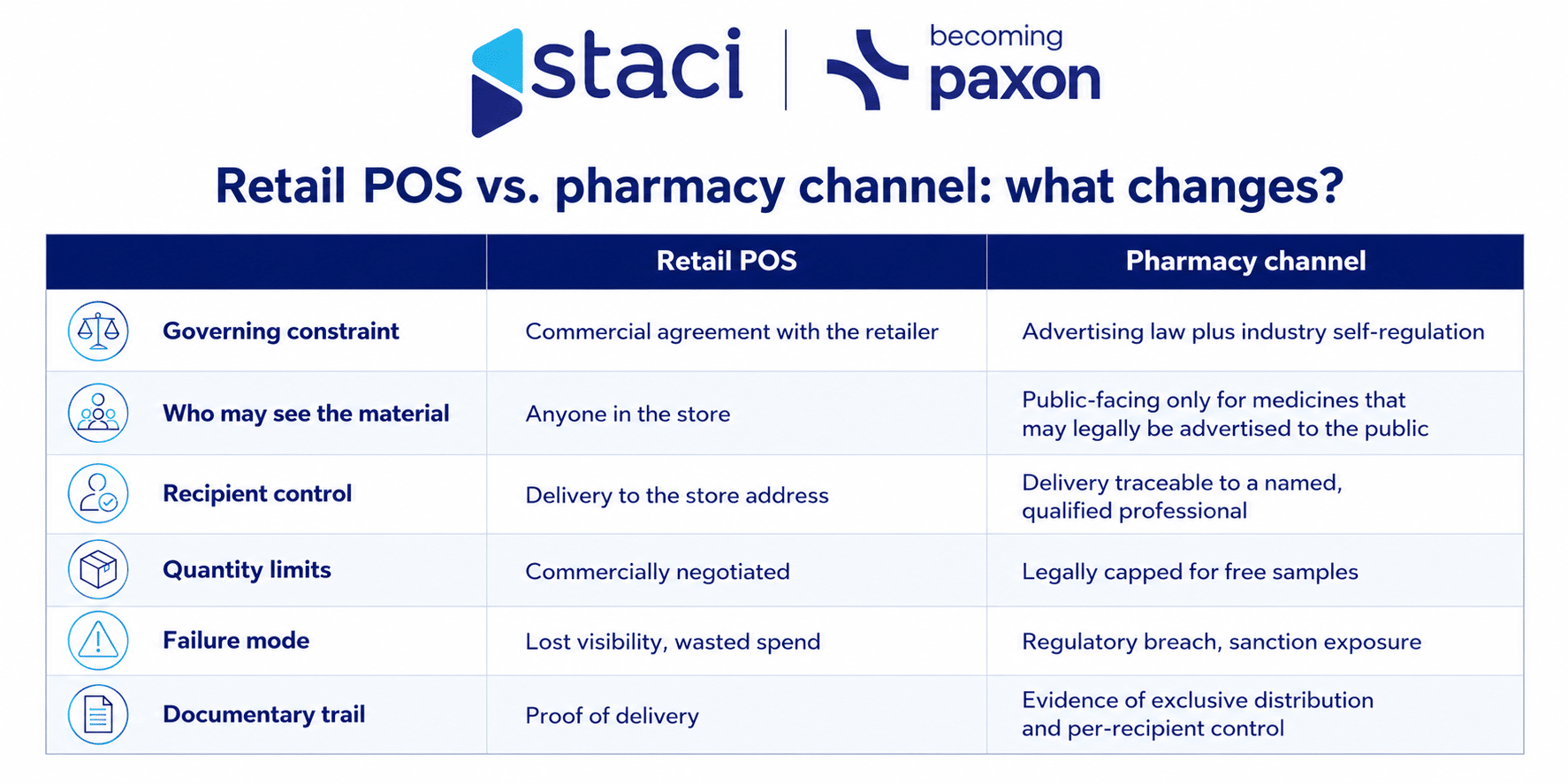
Retail and pharmacy look similar on a distribution list. They are governed by entirely different logic. In retail, the constraints are commercial: the planogram, the store format, the retailer’s own approval process, the delivery window negotiated with the chain’s platform, the space the category manager actually granted. Get it wrong and you lose visibility.
In the pharmacy channel, the constraints are legal, and they attach to the material itself rather than to the agreement with the outlet. Get it wrong and the brand -not the operator, not the agency – is exposed.
What Spanish law actually demands from pharma campaign material
Most brands treat the regulatory layer as a legal-affairs matter and the distribution layer as a logistics matter. The regulation does not respect that division.
Beyond the exclusion of prescription-only medicines from public-facing advertising, Royal Decree 1416/1994 also excludes medicines forming part of the National Health System’s pharmaceutical provision (art. 7.2). It requires that professional promotional media be distributed exclusively to persons qualified to prescribe or dispense medicines(art. 15.2). And it obliges the marketing authorisation holder to send the health authority a copy of all advertising together with a record indicating the recipients, the means of diffusion and the date of first diffusion (art. 21.a).
Read that last clause as an operations brief rather than a legal one. A record of recipients is not something a legal department can generate after the fact. It is generated, or it is not, by whoever physically dispatched the material.
The industry’s own self-regulation points the same way. The Farmaindustria Code of Good Practice requires that promotional material for prescription medicines be sent exclusively to healthcare professionals qualified to receive it, and that mailing lists be updated periodically, with removal requests honoured (art. 7.1 and 7.2).
It also sets hard monetary ceilings on what may accompany that material:
- €10 — the maximum market price for professional-use utensils or stationery, and only if unrelated to a prescription medicine (art. 10.1).
- €70 — the threshold below which educational or informational materials count as low value (art. 10.2.1).
Then comes the clause that puts the logistics provider inside the perimeter. Company procedures must, in the Code’s own words, ensure that the subcontractors and suppliers used to execute these activities know and respect the Code’s rules. A 3PL handling pharma campaign material is not a neutral carrier. It is a named part of the client’s compliance chain.
Free samples are a warehouse operation, not a marketing line item
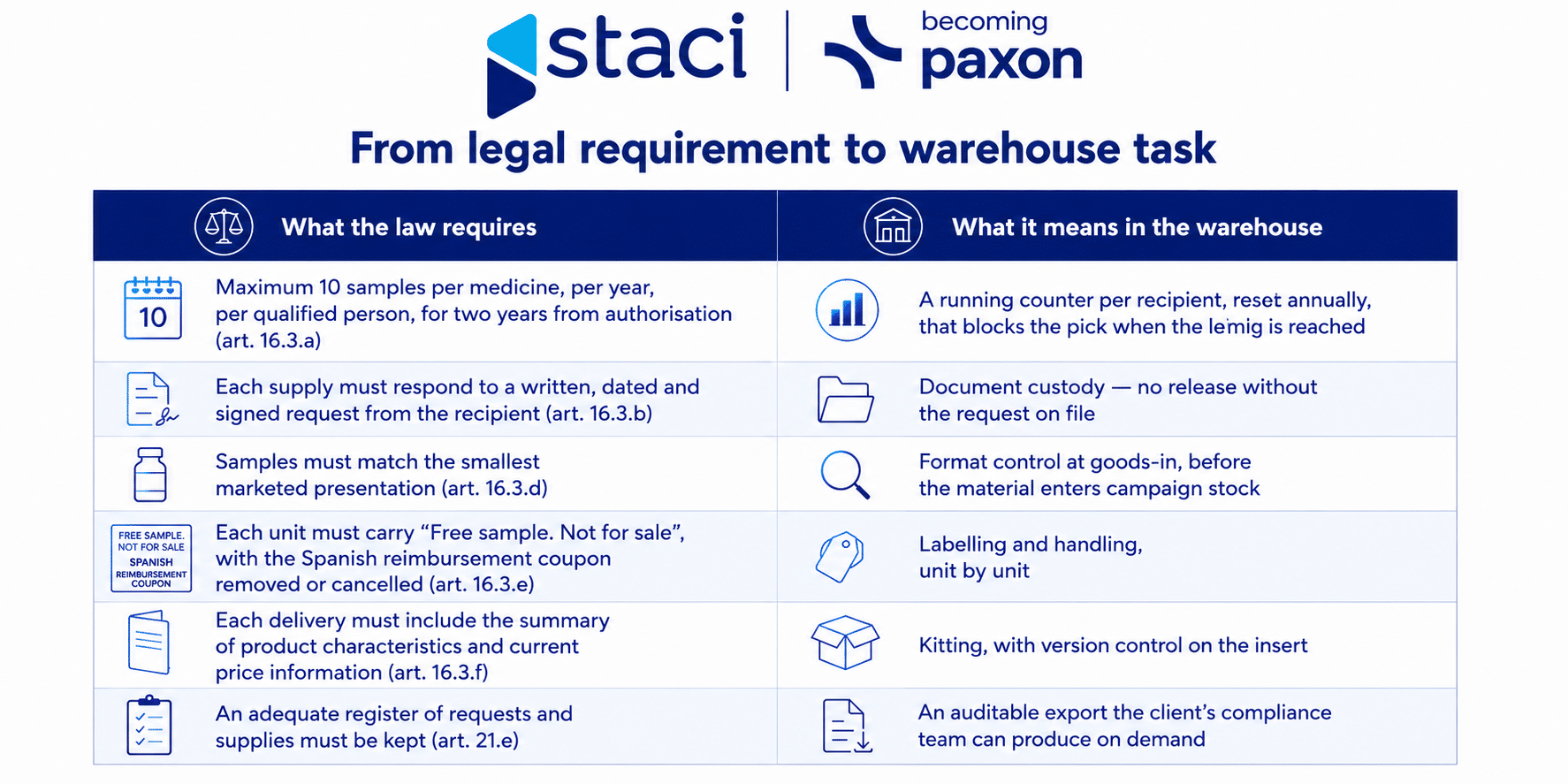
Nowhere is the gap between regulation and operations wider than with free samples. Royal Decree 1416/1994 sets six requirements. Every one of them is a physical task performed by whoever holds the stock.
Why the delivery note is the compliance record
In retail, proof of delivery answers a commercial question: did the service happen. In pharma campaign logistics it answers a regulatory one: can you demonstrate that this material reached only those entitled to receive it, and that no recipient exceeded their limit.
That is a different data model. Batch-level traceability- the standard that governs temperature-sensitive pharmaceutical flows– tells you which units left and under what conditions. It does not tell you whether the named cardiologist in Zaragoza has now received eleven samples across two campaigns run by two different agencies.
Recipient-level traceability does. It requires the operator to hold an identity for every delivery point, to reconcile against a qualified-professional master file, to age the counters annually, and to produce an auditable export on request. This is the same traceability technology discussion that applies to any international operation, pointed at a different object: not the product, but the person who received it.
Allocation: why 100% of the material should never go to 100% of the points
The default instruction to a campaign logistics provider is some version of «send everything everywhere». It is almost always the most expensive option available.
Spain’s pharmacy network illustrates why. The country closed 2025 with 22,273 community pharmacies, 42 more than the previous year, according to the Spanish General Council of Official Colleges of Pharmacists. More relevant for anyone planning a drop: 14,371 of them -64.5%- sit outside provincial capitals, roughly double the number located in those cities, giving an average of 4.5 pharmacies per 10,000 inhabitants.
That capillarity is the network’s social strength and the campaign planner’s cost problem. A national pharmacy drop is not one logistics operation; it is a dense urban operation and a highly dispersed rural one sharing a single line in the budget. Sending an identical kit to all of them ignores that a rural pharmacy with two square metres of free counter space and an urban parapharmacy with a dedicated dermocosmetics wall cannot use the same material.
An allocation matrix fixes this before the pick list is built. Outlets are profiled- by format, by surface area, by category mix, by whether the outlet is public-facing for this particular product- and each profile receives a defined kit. The same discipline applies on the retail side, where store format and planogram allocation determine which display is physically installable.
The cost of over-allocation
Material sent to a point that cannot use it does not simply disappear. It is stored in a back room, returned at the brand’s expense, or thrown away without any record. The cost is paid three times: once in production, once in transport, and once in the reverse flow nobody budgeted for.
Kitting and co-packing: where the campaign is actually assembled
The physical build of a campaign is the least visible and most failure-prone stage. Display units arrive flat from one supplier, printed material from another, product from a third, and something has to combine them in the right proportions per destination profile.
For POS material this means pre-assembly where the outlet cannot assemble on site, protective packing sized to survive a non-palletised delivery, and grouping by destination so a single store receives one consignment rather than four. Campaigns running across several markets add language and regional variants to the same build, a coordination problem familiar from any multi-country sponsor activation.
For pharma material, kitting is where the regulatory requirements are physically satisfied: the summary of product characteristics inserted alongside each sample, the labelling applied, the price information updated to the current version. The Farmaindustria Code requires that promotional material not be distributed until its final version has been reviewed and approved by the company’s scientific service (art. 9.2). That approval has to reach the warehouse before the kit is sealed, not after it ships.
Decentralised ordering: sales teams, medical reps and budget control
Campaign material is rarely ordered centrally. Sales representatives, medical representatives, regional managers and local marketing teams all draw from the same stock, usually without visibility of what remains or what their colleagues have taken.
A platform layer solves the two problems that follow. The first is stock: a catalogue with real-time availability stops teams ordering material that ran out three weeks ago. The second is control: per-user quotas and budget ceilings turn an open stockroom into a governed one, which matters commercially in retail and matters legally in pharma, where the €10 and €70 thresholds in the Farmaindustria Code apply per item regardless of who requested it.
Ecats Staci is built for exactly this pattern: an ISO 27001-certified platform with a client-managed catalogue, real-time stock control, user-level permissions and pricing managed by the client rather than by the operator.
The material that comes back: withdrawal, refurbishment and certified destruction
Campaign material has an ending, and the ending is where most of the unrecorded cost sits. Some of it is reusable. Modular display structures, frames and stands can be withdrawn, inspected, refurbished, stored and redeployed for the next campaign, the same reverse logistics discipline applied to marketing assets rather than to consumer returns.
Some of it cannot be reused under any circumstances. The Farmaindustria Code requires that printed promotional material carry the essential information from the current summary of product characteristics, specifying the date on which that information was last prepared or revised (art. 2.1.a). When a summary of product characteristics changes, every unit of printed material referencing the previous version becomes non-compliant immediately, regardless of how much of it is sitting in a warehouse. At that moment the operation needed is not storage but documented destruction, with a certificate the brand can file.
Building that ending into the brief at the start, rather than discovering it eighteen months later during a stock count, is the difference between a managed asset and a liability nobody owns.

What to ask an operator that runs both channels
Temperature control and cold-chain certification dominate most pharma logistics conversations, and they are covered in depth elsewhere in this blog. For campaign material specifically, the questions that separate operators are different:
- Can you enforce a per-recipient ceiling? Not report on it afterwards — block the pick when a recipient has reached the annual limit.
- Can you evidence exclusive distribution? Ask to see the format of the recipient record the operator would hand to a client’s compliance team.
- Can you hold and retrieve the signed sample requests that a regulator or an internal audit would ask for, and for how long?
- Can you split a single campaign into two documentary regimes– one retail, one regulated- without running two separate projects and two separate cost bases?
- Can you assemble to a profile matrix rather than to a flat quantity per destination?
- Can you handle the reverse flow, including refurbishment for reuse and certified destruction with documentation?
- Will your teams accept being inside the client’s compliance perimeter, as the Farmaindustria Code requires of subcontractors and suppliers?
An operator who answers the first four comfortably is working in this channel already. One who treats them as unusual requests is not.
Campaign logistics that holds up under audit
The brands that run POS and pharma campaign material well are not the ones with the largest budgets. They are the ones that stopped treating the physical layer as an afterthought to the creative one, and hired for the documentary discipline rather than for the delivery price.
Staci operates logistics platforms in Barcelona and Alcalá de Henares covering more than 34,000 m², serving FMCG, pharma, cosmetics, retail and automotive brands across both regulated and open channels. That combination –healthcare logistics discipline applied to campaign material, with the platform layer to govern who orders what- is what allows a single campaign to cross a supermarket aisle and a pharmacy counter without the brand discovering the difference too late.
FAQs
Can the same display be used in a supermarket and a pharmacy?
Only if the product it promotes may legally be advertised to the public. Prescription-only medicines are excluded from public-facing advertising under Royal Decree 1416/1994, as are medicines covered by the National Health System’s pharmaceutical provision. For over-the-counter products and parapharmacy lines, the material itself is generally transferable, though the physical format usually is not, pharmacy counter space rarely accommodates retail floor units.
Who is responsible if promotional material reaches an unauthorised recipient?
The marketing authorisation holder carries the regulatory responsibility. However, the Farmaindustria Code explicitly requires companies to ensure that their subcontractors and suppliers know and respect the Code, which means the operator’s failure becomes the brand’s exposure. Contractually, this is why recipient-level records matter more than delivery-level ones.
How many free samples can a laboratory send to one prescriber?
A maximum of 10 samples of each medicine per year per qualified person, for up to two years from the medicine’s authorisation date, and only in response to a written, dated and signed request from that recipient.
Does campaign material need a separate warehouse from product stock?
Not necessarily a separate building, but it does need separate handling logic. Campaign references have no rotation history, no reorder point and a fixed expiry tied to a calendar date rather than to the product, which makes standard replenishment rules useless for them.
What happens to printed material when a summary of product characteristics is updated?
It becomes non-compliant from that moment, because the Farmaindustria Code requires printed promotional material to reflect the current summary of product characteristics and to carry its revision date. The stock must be withdrawn and destroyed with documentation rather than stored.
Is a general logistics provider enough for POS material if no medicines are involved?
For purely retail campaigns, often yes, provided the provider can handle non-palletised, format-dependent, date-critical flows. The moment the same campaign touches the pharmacy channel with a regulated product, the documentary requirements change and a generalist provider becomes a risk rather than a saving.
How far in advance should campaign material logistics be planned?
Early enough that the allocation matrix and the kit specification exist before production quantities are committed. Ordering the material first and deciding its distribution afterwards is the single most common cause of over-production in this category.
References
- Royal Decree 1416/1994, of 25 June, regulating the advertising of medicinal products for human use
- Code of Good Practice of the Pharmaceutical Industry
Farmaindustria, 2025 edition, ratified at the General Assembly of June 2025. - InfoAdex Study of Advertising Investment in Spain 2026
InfoAdex, 32nd edition, covering the 2025 financial year. - Statistics on Registered Pharmacists and Community Pharmacies 2025
General Council of Official Colleges of Pharmacists of Spain.