

A score of 5.4 out of 10 for stock-out prevention. That is how Spanish hospital pharmacies rated pharmaceutical laboratories in AECOC’s latest hospital pharmacy benchmark. The match between references ordered and received scored 5.5, as did temperature management.
These results reveal some of the challenges facing pharmaceutical supply chains in Spain. Although the scores assess laboratories rather than logistics operators, warehousing, distribution, inventory visibility and order fulfilment all influence the service received by hospital pharmacies.
The study gathered the views of 40 public hospitals from every autonomous community, four large private hospital groups and 36 pharmaceutical laboratories. Its findings offer a useful starting point for companies looking for the best logistics operators for pharma companies in Spain: rather than comparing warehouse capacity alone, laboratories should assess which operational capabilities address their specific distribution needs.
Is there an independent ranking of the best pharma logistics operators in Spain?
There is no single public, independent ranking identifying the best pharmaceutical logistics operator in Spain. Individual providers describe their capabilities, while industry benchmarks typically assess supply chain performance rather than comparing operators directly.
AECOC’s study provides a relevant perspective because it captures the experience of hospital pharmacies, one of the most demanding pharmaceutical distribution channels.
Hospital pharmacy managers identify order management as a critical stage in the service. Their main concerns include stock-outs, which can last several days, and discrepancies between the references requested and those delivered. Goods receipt is another important area, with attention focused on transport conditions, temperature compliance and product integrity. Invoicing and delivery also present opportunities for improvement.
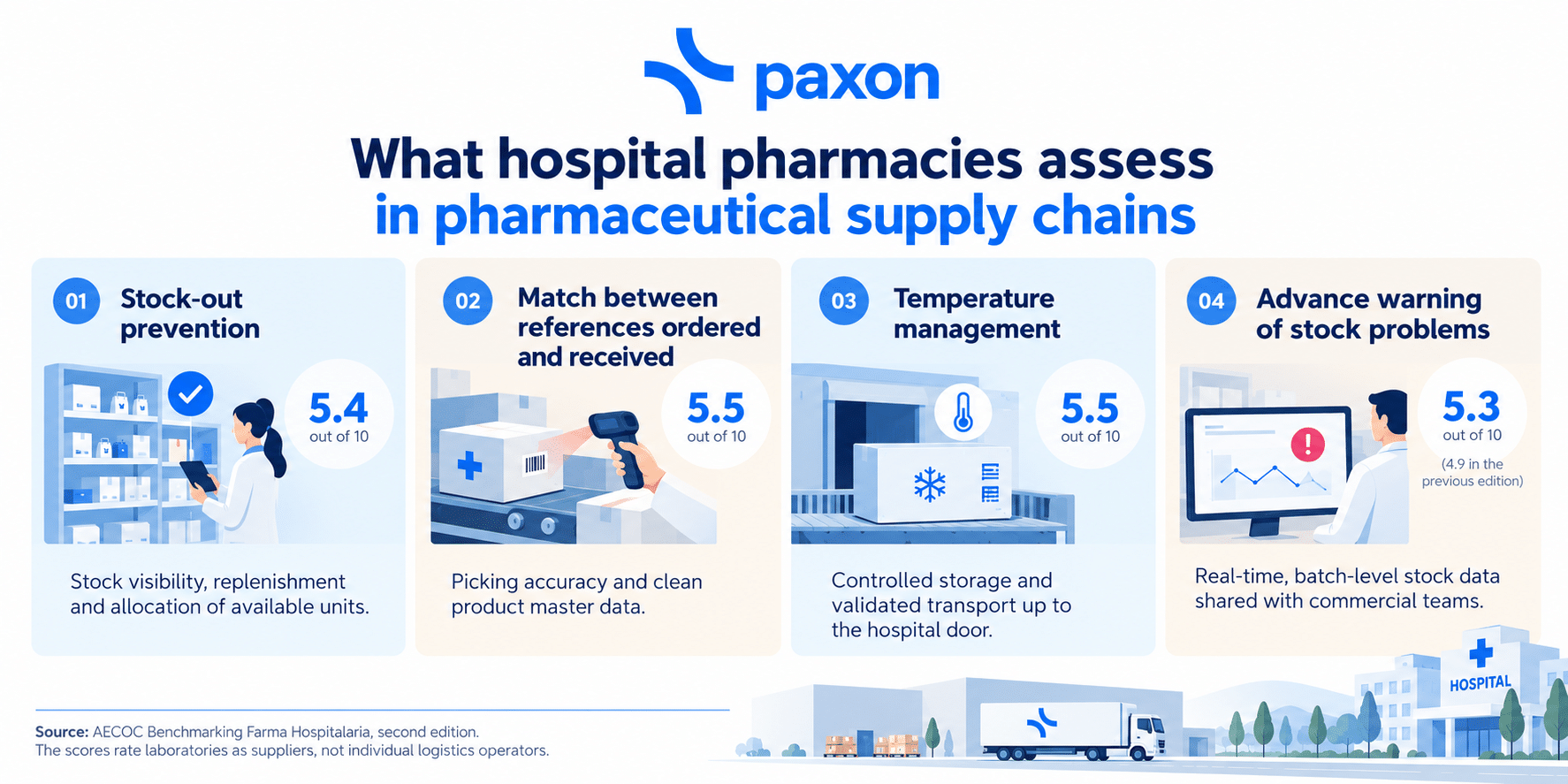
The results underline the importance of coordination between laboratories and their logistics partners. Advance warning of stock problems also received a relatively low assessment. Although communication with hospitals is primarily a commercial responsibility, it depends partly on accurate information generated throughout the supply chain.
As Óscar Castroviejo, AECOC’s head of health, has highlighted, hospitals continue to demand earlier notification of potential shortages and more reliable information about product availability.
For commercial teams to provide that information, laboratories need visibility of inventory, outstanding orders and expected replenishment. Logistics systems can therefore contribute to better communication between warehouses, laboratories and healthcare professionals.
Other shortcomings also have an operational dimension. Discrepancies between ordered and delivered references may arise from picking errors, inaccurate master data or order-processing issues. Temperature incidents may reflect problems in storage, transport, monitoring or handling procedures.
Each of these weaknesses highlights an area where the capabilities of a logistics partner can influence service quality.
Why do these results matter as the Spanish pharmaceutical market grows?
The findings become particularly relevant when considered alongside the evolution of the Spanish pharmaceutical market.
According to IQVIA data included in the AECOC study, the market grew by 12.4% in value in 2025, reaching €36,525 million at ex-factory prices. The hospital segment expanded even faster, recording growth of 16.2% and accounting for 62.7% of the total market.
A substantial share of pharmaceutical market value is therefore concentrated in a channel where service expectations are high and several operational indicators still show considerable room for improvement.
At the same time, medicine availability remains a concern. The Spanish Agency of Medicines and Medical Devices (AEMPS) recorded 2,345 medicine supply problems in 2025. During the second half of the year, 1,151 presentations were affected, representing 3.5% of authorised presentations.
There are positive developments: supply problems with a major impact on patients fell by 17.4% during the year. Nevertheless, the causes identified by AEMPS demonstrate why supply chain performance requires a broader perspective.
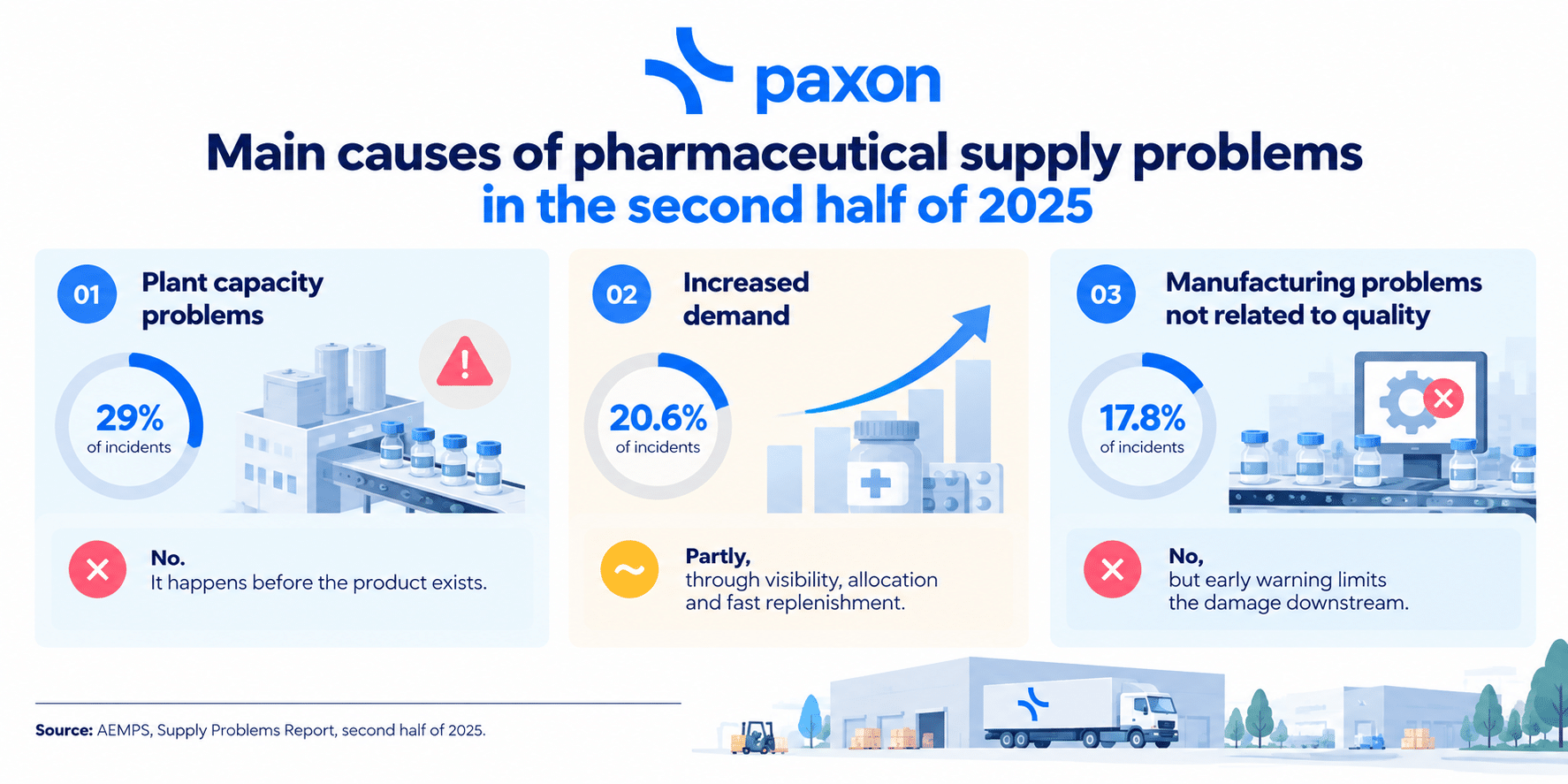
Manufacturing constraints, production incidents and unexpected increases in demand cannot always be prevented by a logistics operator. However, their consequences can be influenced by how existing stock is managed.
Accurate inventory information, appropriate allocation, effective order fulfilment and timely communication help laboratories respond when availability becomes limited. Rather than expecting an operator to solve every supply problem, pharmaceutical companies should assess which risks fall within its responsibilities and how effectively it can manage them.
Which logistics model fits each pharmaceutical need?
Pharmaceutical logistics is not a uniform activity. Different operators have developed capabilities around specific distribution channels, product characteristics, operational volumes and geographical requirements.
A laboratory distributing temperature-sensitive medicines to hospitals may have very different needs from one managing international flows or commercial materials for its sales representatives.
The objective is therefore to identify which logistics model best matches each type of operation.
For medicines, regulatory compliance is essential. Storage and distribution must be performed by appropriately authorised entities operating under applicable Good Distribution Practice requirements. We explored these obligations in our guide to contract logistics for pharma and cosmetics in Spain.
The channel-access specialist: Logista Pharma
Logista Pharma specialises in pharmaceutical distribution to hospitals, pharmacies and other healthcare centres in Spain. Its extensive network and temperature-controlled capabilities make it particularly suitable for laboratories prioritising healthcare-channel reach, stock availability and delivery reliability.
The healthcare-only operator: Movianto
Movianto focuses on healthcare logistics, combining regulated warehousing, distribution and value-added services within a European network. Its model is particularly suited to laboratories requiring temperature control, traceability and specialised pharmaceutical handling.
The international network: DSV
DSV combines healthcare warehousing with international air, sea and road freight services and customs management. Its integrated network is especially relevant for laboratories managing cross-border pharmaceutical flows, imports and international distribution.
The large-scale contract operator: ID Logistics
ID Logistics specialises in large-scale contract logistics, with dedicated healthcare capabilities and experience managing complex distribution operations. Its model is particularly relevant for pharmaceutical companies requiring scalability, high-volume fulfilment and flexibility during demand peaks.
The specialist in flows around the medicine: Paxon
Pharmaceutical companies manage much more than the movement of medicines. Alongside regulated product distribution, laboratories coordinate samples, point-of-sale materials, printed detailing materials, medical devices, spare parts, field-force kits and congress logistics.
These activities often involve numerous references, smaller shipments, multiple recipients and frequent changes associated with commercial campaigns.
Paxon specialises in these flows, supporting laboratories with the storage, preparation and distribution of materials that accompany their commercial operations.
Its model complements authorised medicine distribution rather than replacing it. While pharmaceutical distributors handle medicinal products within the relevant regulatory framework, Paxon focuses on the wider logistics activities surrounding them.
Key evaluation priorities: order accuracy, recipient traceability, inventory visibility and campaign fulfilment.
Which KPIs should pharma companies monitor?
Choosing a logistics operator requires more than reviewing its infrastructure or geographical coverage. Performance must be measurable through indicators that reflect the operational risks associated with each activity.
General KPIs such as on-time, in-full delivery (OTIF) and inventory accuracy remain important, as explored in our guide to 3PL performance in retail. However, pharmaceutical logistics requires additional indicators linked to product availability, order accuracy, temperature compliance and traceability.
- Stock-out prevention
Preventing stock-outs depends on accurate inventory visibility, demand forecasting and effective order management. Although logistics operators cannot prevent manufacturing-related shortages, they can help anticipate risks and minimise avoidable disruptions.
Three KPIs are particularly relevant: line fill rate on hospital orders, which measures the percentage of order lines supplied in full; days of cover by batch and expiry, which indicates how long usable stock can meet demand before expiration; and backorder age, which tracks how long orders remain unfulfilled.
Together, these indicators help laboratories assess stock availability, identify potential shortages and improve supply reliability.
- Match between references ordered and received
Order discrepancies can originate in warehouse preparation, product identification or inaccurate master data. Distinguishing between these causes is essential for implementing effective corrective measures.
- Order line accuracy measures the proportion of deliveries containing the correct reference, quantity and applicable batch information. Master-data error rate identifies inaccuracies in product records, including codes, units of measure and packaging specifications.
Monitoring both indicators helps determine whether problems arise from operational execution or the information used to process orders.
- Temperature management
Providing temperature-controlled logistics involves more than maintaining the required temperature range. Operators must also document conditions, detect deviations and respond appropriately when incidents occur.
Three KPIs are particularly important: temperature excursion rate, which measures deviations from authorised conditions; complete-record rate, which assesses the availability of temperature documentation; and time to disposition, which measures how quickly a documented decision is reached following a deviation.
Targets should reflect the product’s characteristics, qualified transport routes and agreed quality procedures rather than generic benchmarks.
- Advance warning of stock problems
Early communication about potential shortages allows laboratories and healthcare providers to respond before disruptions become critical.
Warning lead time measures the interval between detecting a potential stock risk and communicating it to the relevant laboratory team. Availability forecast accuracy compares projected inventory with actual stock levels.
These indicators are particularly valuable when warehouse systems, demand planning and commercial teams share reliable, up-to-date information.
- Control KPIs behind every operation
Beyond individual service indicators, pharmaceutical companies should assess an operator’s ability to maintain control when incidents occur.
Traceability response time measures how quickly products from a particular batch can be located across the distribution network, demonstrating the value of effective traceability technology.
Recall execution time assesses how efficiently affected inventory can be blocked, recipients identified and the recall process documented. Meanwhile, CAPA closure time measures the time required to complete corrective and preventive actions following an incident.
Together, these indicators help evaluate operational reliability, regulatory readiness and the ability to respond to unexpected situations.
The relevance of each KPI depends on the product, distribution channel and operational requirements involved. Pharmaceutical companies should therefore prioritise indicators that reflect their specific risks and ensure prospective logistics partners can demonstrate their performance in practice.
What should a pharma company test before signing?
A logistics provider’s stated capabilities are important, but pharmaceutical companies should also seek practical evidence of operational performance.
Two simulations can provide valuable information during a tender: a mock stock-out and a mock recall. Both should be adapted to the activities the operator is authorised and contracted to perform.
- The mock stock-out
A stock-out simulation assesses how quickly an operator can identify an emerging availability problem and provide the information needed to respond.
For example, the laboratory can establish a scenario in which a reference is expected to run short within ten days. The operator should demonstrate its ability to identify available stock by batch and expiry date, outstanding orders, affected customers and information supporting allocation and communication decisions.
The exercise should measure response time and data reliability. Quick access to accurate information gives laboratories a stronger basis for managing potential disruptions.
- The mock recall
A recall simulation tests whether an operator can locate affected products, prevent further distribution and support established recall procedures.
The exercise should demonstrate the ability to block affected inventory, locate units in storage or transit, identify recipients and coordinate collection and quarantine through appropriate reverse logistics procedures.
A complete status report should document the actions performed and any outstanding issues.
These exercises provide tangible evidence of operational readiness and should complement the review of authorisations, quality agreements, technological capabilities and service-level commitments.
Paxon: a specialist partner for pharma’s commercial flows in Spain
Alongside regulated medicine distribution, pharmaceutical companies manage a complex network of materials supporting their commercial, marketing and healthcare engagement activities.
These operations require specialised logistics capabilities, particularly when they involve numerous references, small orders, geographically dispersed recipients and frequently changing campaigns.
Paxon focuses on these flows, helping laboratories organise the storage, preparation and distribution of commercial and promotional materials.
With seven centres in Barcelona and Madrid covering more than 42,000 m², Paxon handles samples, point-of-sale materials, printed detailing materials, medical devices and spare parts, delivering to pharmacies, healthcare professionals, hospitals, medical representatives and professional congresses.
Its experience also extends to international projects. One example involves a global pharmaceutical group seeking to decentralise its logistics, marketing, advertising and promotional activities across European markets while maintaining a single provider.
Paxon established one European contract covering Spain, France, Germany, Italy, the UK and Benelux, with local inventory, operational contacts, harmonised procedures and unified reporting.
The operation manages 1,800 references and 2,600 pallets, handling 35,000 orders and 70,000 parcels annually while supplying 1,500 medical representatives across Europe.
Technology plays an important role in maintaining this level of coordination. Through Ecats Paxon, laboratories and field teams can access inventory, order and campaign information, improving visibility and control across commercial operations.
These capabilities are particularly relevant when materials must reach multiple healthcare professionals while maintaining accuracy and traceability. Product classification and applicable documentation requirements must also be considered, as explored in our guide to POS and pharma campaign materials.
For pharmaceutical companies, the most effective logistics strategy is not necessarily the one that concentrates every activity under a single provider. It is the one that combines the right capabilities for each flow.
Authorised pharmaceutical distributors remain essential for the movement of medicines. Specialist partners such as Paxon complement those activities by managing the commercial and promotional materials that support laboratories’ relationships with healthcare professionals.
If your company needs greater visibility, traceability and operational control over these activities, talk to the Paxon team to learn more about our healthcare logistics services.
Best logistics operators for pharma companies in Spain: frequently asked questions
What are the best logistics operators for pharma companies in Spain?
There is no single independent ranking. Operators with documented pharmaceutical capabilities include Logista Pharma, Movianto, DSV and ID Logistics, each offering different specialisations. Paxon focuses on the commercial and promotional flows surrounding medicines.
How do hospital pharmacies rate pharmaceutical supply in Spain?
According to AECOC’s second hospital pharmacy benchmark, stock-out prevention scored approximately 5.4 out of 10, while reference accuracy and temperature management both scored around 5.5.
Can a logistics operator prevent medicine shortages?
Not all shortages can be prevented through logistics, particularly those originating in manufacturing. However, operators can improve inventory visibility, order fulfilment, early warning and distribution of available stock.
Which KPIs matter most in pharmaceutical logistics?
Relevant indicators include line fill rate, order accuracy, temperature excursion rate, traceability response time, recall execution time and CAPA closure time, depending on the product and distribution channel.
Does a pharma company need one logistics operator for everything?
Not necessarily. Laboratories may combine authorised medicine distributors with specialised partners for samples, POS materials, medical devices and field-force supplies.
How can I test a logistics operator before signing?
Mock stock-out and recall simulations can help assess response times, data accuracy and operational readiness, alongside regulatory and quality assessments.
Bibliography
- AECOC. Benchmarking Farma Hospitalaria, second edition. Published via Logística Profesional, 15 April 2026.
- IQVIA. Spanish pharmaceutical market data 2025, as included in the AECOC Benchmarking Farma Hospitalaria study.
- AEMPS. Informe sobre Problemas de Suministro. Segundo semestre de 2025. Published 28 January 2026.
- AEMPS. Los problemas de suministro de medicamentos de impacto mayor se reducen un 17% en 2025. Press release.
- Paxon. Nuestros logros: Sanidad and Logística sanitaria.
- Public corporate information from Logista Pharma, Movianto, DSV and ID Logistics.