

Spanish law has a name for the warehouse that stores someone else’s medicines: almacén por contrato. It has no equivalent for a face serum, a sun cream or a bottle of perfume. That asymmetry is the first thing to understand about contract logistics for pharma and cosmetics in Spain. The two categories often share a buyer, a sales channel and even a pharmacy shelf, but they follow different rules, and so does the operator that handles them.
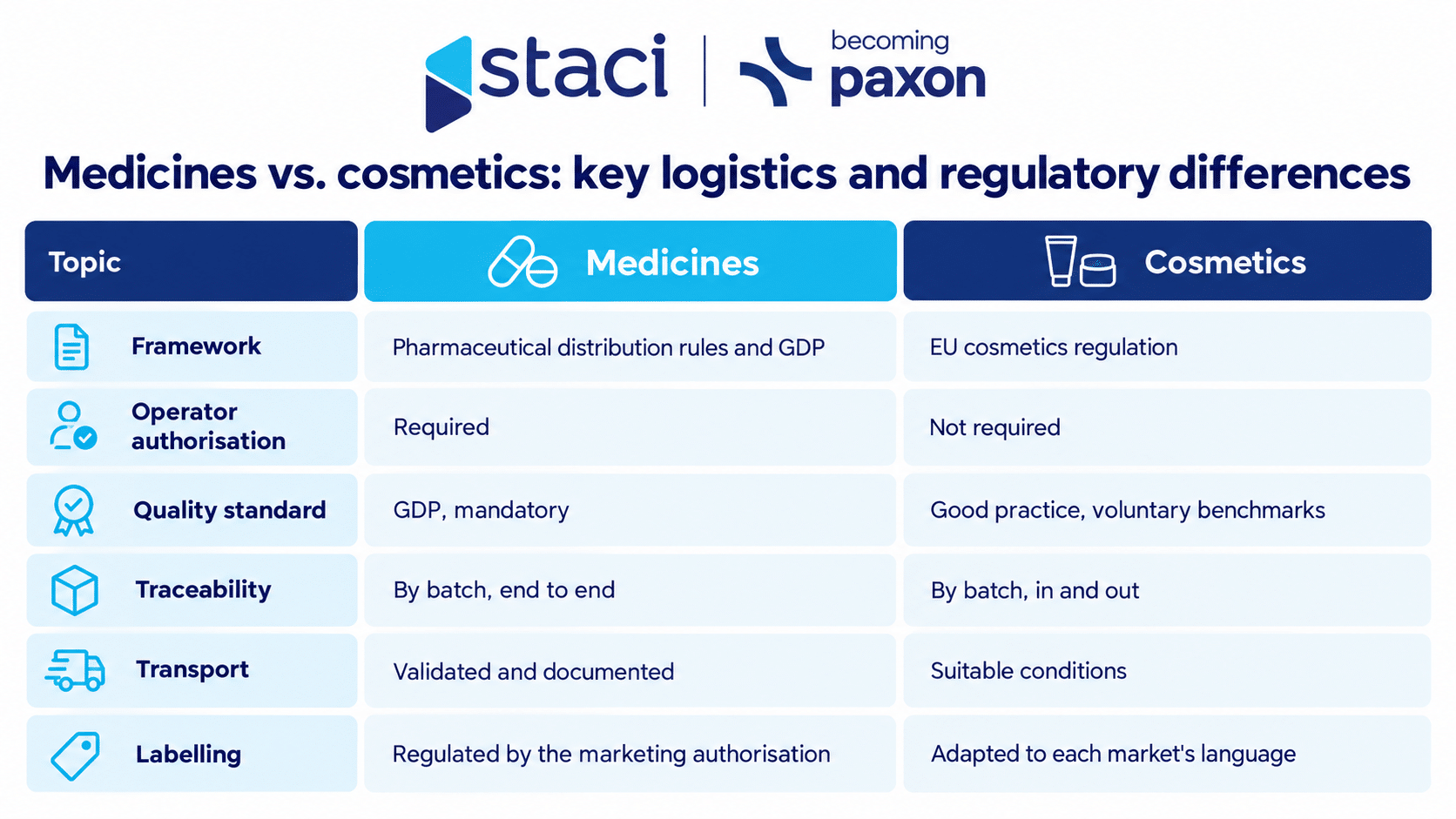
Medicines can only be stored and distributed by authorised entities working to Good Distribution Practice (GDP). Cosmetics follow EU cosmetics regulation, which asks less in terms of authorisations but still expects care in storage, transport and traceability. Choosing a logistics partner starts with knowing which of your products sits where, and whether the operator is the right fit for each one.
Why is Spain a strategic hub for pharma and cosmetics contract logistics?
Spain is both a manufacturing base and an export platform for the two industries. Its pharmaceutical production is concentrated in Catalonia and Madrid, the same two regions that anchor the country’s logistics network.
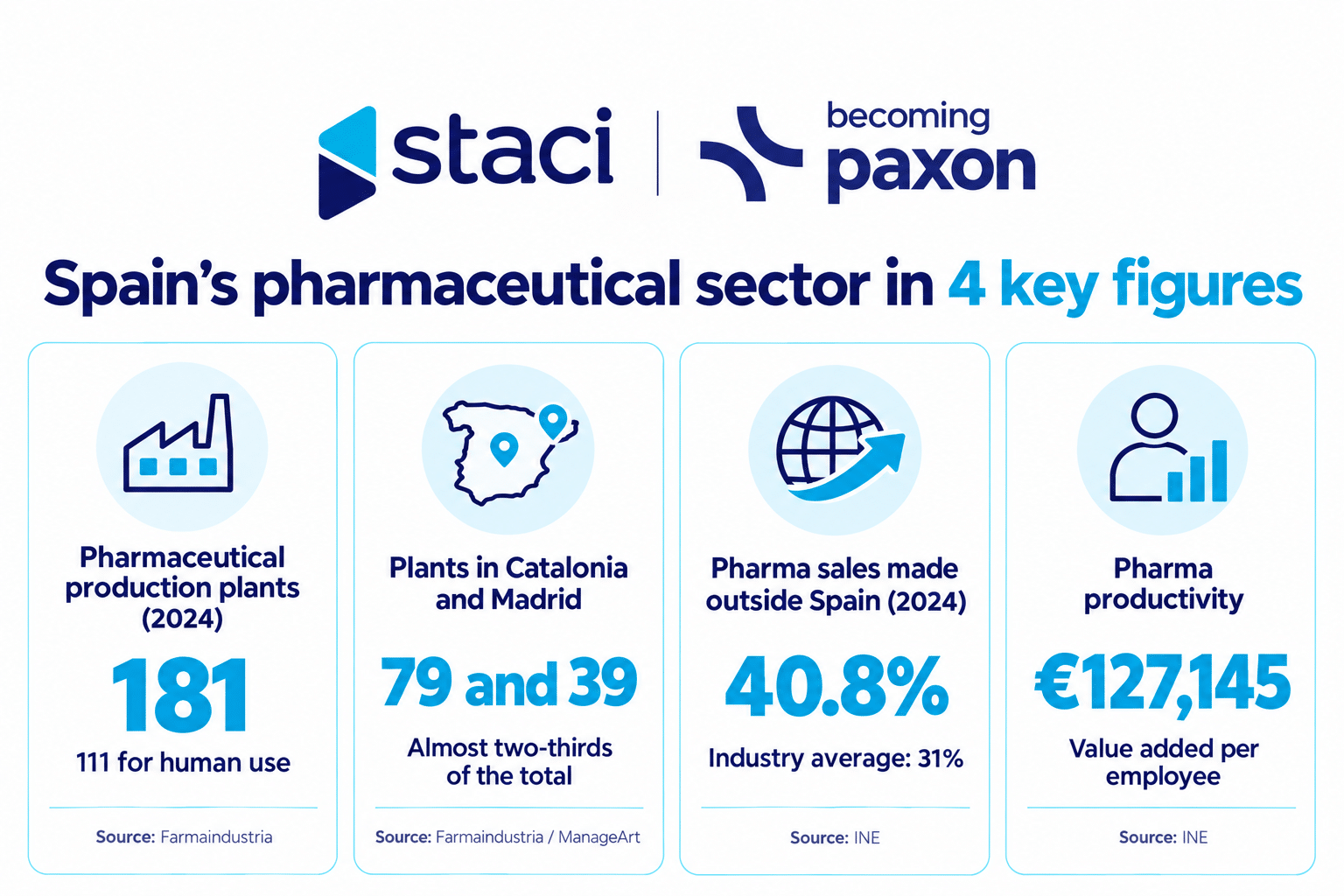
Spain closed 2024 with 181 pharmaceutical production plants, 111 of them making medicines for human use, according to Farmaindustria. Catalonia hosts 79 of those plants and the Community of Madrid 39, almost two-thirds of the national total between them. Together, the sector’s plants produce goods worth more than €23,000 million a year, over 30% of Spain’s high-technology manufacturing output.
The destination of that output matters just as much for logistics. The INE’s structural business statistics show that 40.8% of the sales of Spanish pharmaceutical manufacturers in 2024 were made outside Spain, against an average of 31% for industry as a whole. The sector is also the third most productive in Spanish manufacturing, at €127,145 of value added per employee.
Cosmetics adds a second export engine, covered below. For an international brand, the takeaway is practical. Spain’s health and beauty supply chains are built for export, and they cluster where industrial, supplier and logistics capacity already sit.
What does contract logistics mean for pharmaceutical companies in Spain?
Pharmaceutical contract logistics means handing storage, order preparation and distribution to a specialist third party. The laboratory keeps its focus on manufacturing, marketing and regulatory affairs.
In Spain, this is a regulated activity. Royal Decree 782/2013 on the distribution of medicines recognises the contract warehouse as a distribution entity in its own right. It must be authorised for the activities it carries out, and it works under a contract that sets out who is responsible for what.
Two ideas matter for any buyer. First, the operator must be qualified for medicines specifically, not just experienced in logistics. Second, outsourcing the operation does not outsource the responsibility. The laboratory remains accountable for how its products are handled, which is why the contract and the technical agreement behind it deserve as much attention as the price.
Is GDP required for pharmaceutical contract logistics in Spain?
Yes. Any company that distributes medicines on behalf of a laboratory or wholesaler must work to the EU Good Distribution Practice guidelines. Their aim is to protect the quality and integrity of medicines from the warehouse to the pharmacy, and to keep falsified products out of the legal supply chain.
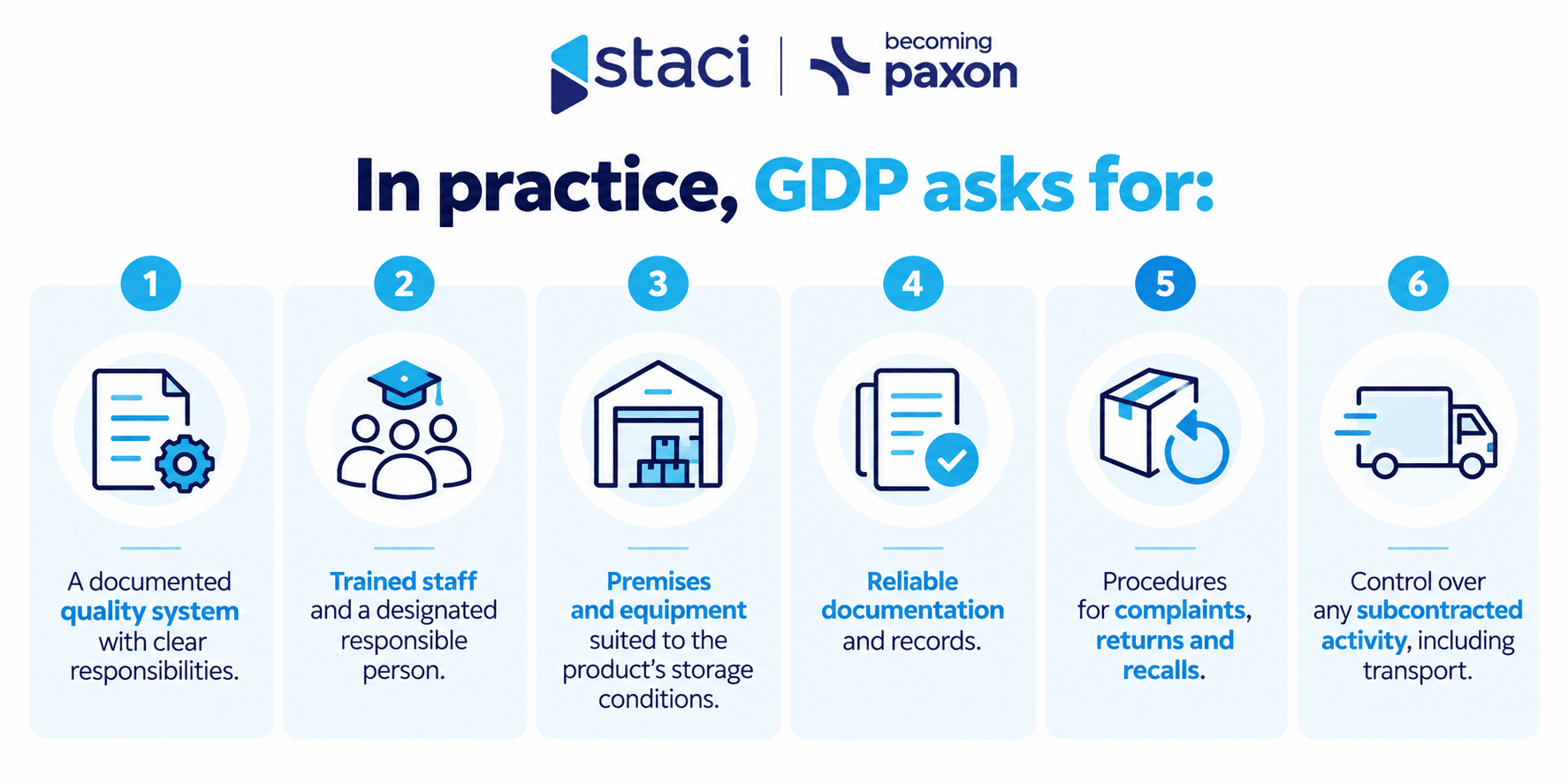
For a pharmaceutical company, the consequence is simple. A logistics provider cannot be chosen on price per pallet or per order alone, because its quality system becomes part of your own supply chain.
Why does validated transport matter in pharmaceutical logistics?
A medicine can leave the warehouse in perfect condition and still be compromised on the road. The storage conditions set by the manufacturer have to be maintained throughout the journey, and the AEMPS considers transport validation mandatory for medicines.
Validation means demonstrating, in advance, that a given route, vehicle and packaging configuration keeps products within their limits. It takes into account transit times, seasonal temperatures and the critical points along the way. Customers can ask to see the monitoring records.
The practical difference is between an operator that offers temperature-controlled logistics and one that can document, shipment by shipment, that pharmaceutical products travelled in the right conditions.
What is different about contract logistics for cosmetics in Spain?
Cosmetics are not governed by pharmaceutical GDP. Their framework is Regulation (EC) No 1223/2009, applied in Spain through national legislation. No specific distribution authorisation is needed. That does not make logistics a free-for-all, because distributors are still expected to:
- store and transport products in conditions that keep them compliant;
- check labelling and expiry dates before products reach the market;
- keep batch traceability, knowing who supplied each batch and where it went;
- adapt labelling to the language requirements of each destination market.
That last point matters for brands selling across Europe from Spain. Relabelling and market-specific packs are a compliance task as well as a marketing one. Many operators also apply GDP principles in cosmetics logistics as a voluntary benchmark, which raises the standard without changing the legal framework.
Why is cosmetics logistics becoming strategically important in Spain?
Because the sector has grown faster than the economy for five years and depends increasingly on exports. Stanpa’s 2025 industry review puts the cosmetics and perfume industry’s contribution to Spanish GDP at 1.03%, up from 0.9%, after cumulative market growth of 44.3% over five years. Spending per inhabitant reached €234.50 in 2025.
Exports more than doubled in the five years to 2024 and now exceed those of wine and olive oil combined. That reach also brings exposure. The United States, the sector’s first destination outside the EU, took €725 million of Spanish beauty exports in 2025, 13% less than the year before, after new tariffs took effect. The Middle East, a strategic market worth €480 million, faces its own logistics disruption.
The pharmacy counter is where the two industries meet. Stanpa reports that pharmacy as a point of sale for cosmetics reached almost €2,100 million in 2024, up 7.7%, with dermopharmacy growing 8.6%. The same laboratory can sell a medicine and a dermocosmetic line through the same outlet, under two different sets of rules. At the smallest end of the spectrum, even a free sachet has to meet cosmetics rules, as we explained in our guide to cosmetics samples logistics.
What services should a pharma and cosmetics contract logistics provider offer?
The exact scope depends on the product, but most health and beauty brands evaluate the same core capabilities.
- Warehousing and inventory control
Storage zones matched to each product’s conditions, with real-time stock visibility by SKU, batch and location.
- Batch and expiry-date traceability
Batch and expiry capture at goods-in and at dispatch, so affected units can be located quickly for a recall, a return or a quality check. This is where traceability technology earns its cost.
- FEFO inventory management
First Expired, First Out picking reduces obsolete stock and unnecessary destruction wherever shelf life matters.
- Temperature management
Each product has its own storage range, and the operator should be able to maintain and record it in the warehouse and on the road.
- Recall and reverse-logistics procedures
The ability to identify, isolate and withdraw affected stock under agreed procedures, and to run reverse logistics without losing batch data.
- Co-packing and promotional logistics
Kitting, gift sets, sampling, inserts, displays and relabelling for specific markets. Co-packing has to respect labelling rules. In the pharma channel, campaign materials also carry their own requirements.
- B2B, retail and ecommerce fulfilment
Pharmacies, wholesalers, retail chains, marketplaces and direct-to-consumer orders served from the same inventory, without losing traceability. The operational requirements are detailed in our guide to choosing an ecommerce warehouse in Spain.
What should international companies check before selecting a pharma logistics provider in Spain?
For medicines, the essentials fit in a short list:
- Authorisation for the specific activities you plan to outsource.
- A working GDP quality system, with a named responsible person.
- Documented temperature control in storage and transport.
- End-to-end batch and expiry traceability.
- Tested procedures for returns and recalls.
- A contract and technical agreement that make responsibilities explicit.
Your own quality and regulatory team should review the detail. For a regional view of the market, see our guide to pharmaceutical fulfilment in Madrid.
What should cosmetics brands check?
For cosmetics, the focus shifts from authorisations to day-to-day control:
- storage conditions suited to each formula;
- batch traceability in and out;
- expiry control and FEFO picking;
- label and language checks for each destination market;
- returns handling that preserves batch data;
- capacity for ecommerce, retail and co-packing from the same stock.
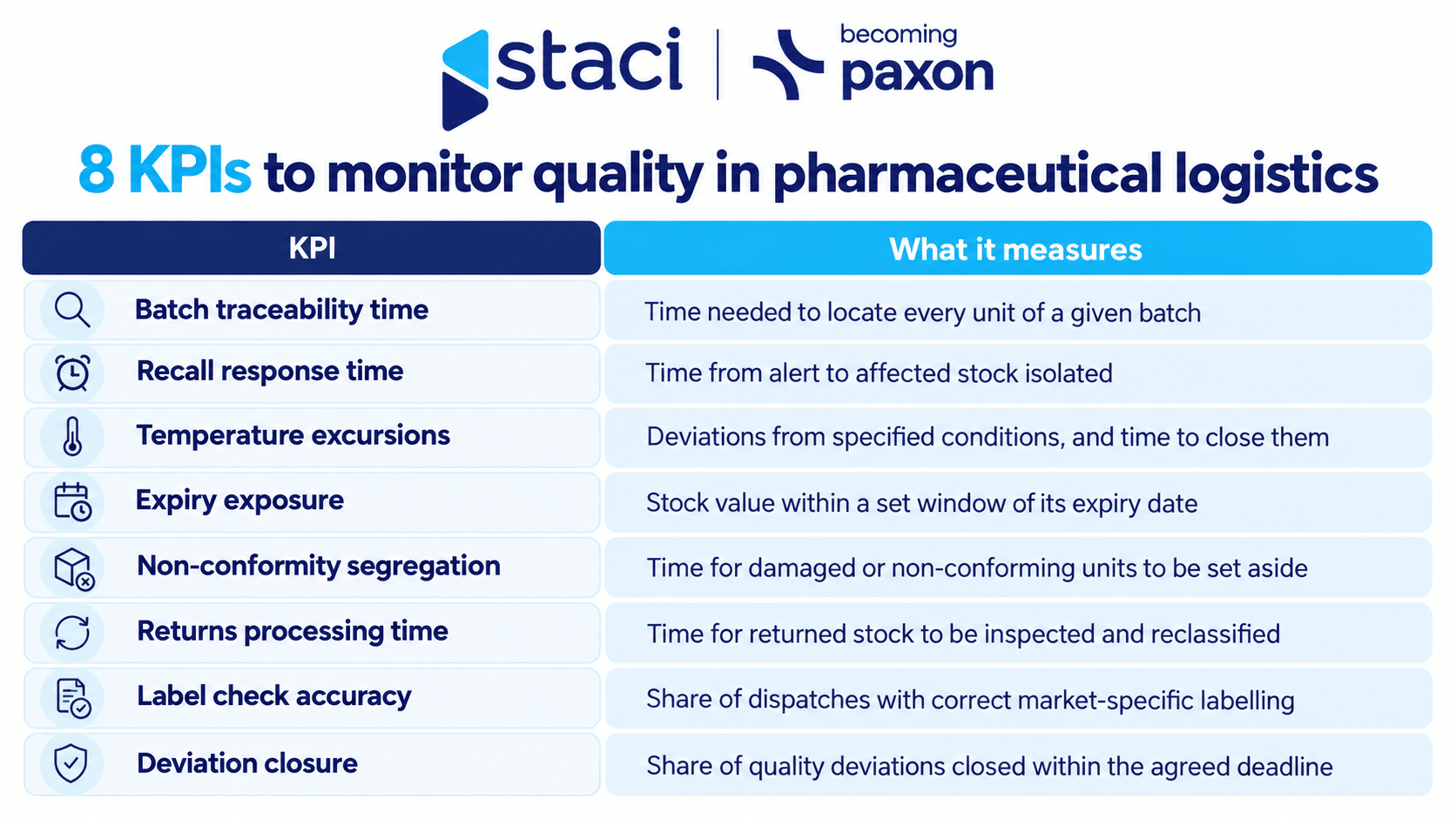
Which KPIs should be included in a contract logistics agreement?
The indicators that matter most for regulated products are the ones that measure control, not just speed. General service indicators such as OTIF, order accuracy and inventory accuracy still apply, and we covered them in our guide to 3PL performance in retail. A health and beauty contract should add these:
Why can one contract logistics partner for pharma and cosmetics create value?
It can, as long as the partner is qualified for every flow it takes on. Groups that sell medicines, dermocosmetics, food supplements and personal care face similar operational challenges under different rules. A single partner can share inventory visibility, automation, fulfilment and value-added services across the portfolio, while keeping separate procedures where each product requires them.
In practice, many health and beauty groups run two models side by side. An authorised contract warehouse handles medicines. A specialised 3PL handles the rest of the portfolio: cosmetics, personal care, supplements and promotional material, often with more flexibility in co-packing, multichannel logistics and campaign work.
The strongest model standardises operations where that creates efficiency and differentiates them where compliance requires it. What it should never do is treat every product the same way.
Staci, your contract logistics partner for health and beauty brands in Spain
The best contract logistics partner is not necessarily the one with the largest warehouse or the lowest handling rate. It is the one whose processes, systems and documentation match the product it handles.
Staci, now part of the pan-European Paxon network, works with cosmetics, personal care and food supplement brands, and supports pharmaceutical companies with the promotional and campaign flows that surround their products. It operates 7 centres in Barcelona and Madrid, with more than 42,000 m². From there it combines batch-controlled storage, unit-level picking, kitting, co-packing, relabelling and distribution to pharmacies, retail chains and consumers.
The visibility layer is Ecats Staci, the group’s platform for real-time stock, order and campaign control, which lets brands open controlled ordering to sales teams and retail networks.
If your health and beauty portfolio needs a partner in Spain, talk to the Staci team about how to structure it.
Contract logistics for pharma and cosmetics: frequently asked questions
What is pharmaceutical contract logistics in Spain?
It is the outsourcing of storage, order preparation and distribution of medicines to an authorised specialist operator, known in Spanish law as an almacén por contrato.
Is GDP mandatory for pharmaceutical logistics in Spain?
Yes. Any company distributing medicines on behalf of a laboratory or wholesaler must work to the EU Good Distribution Practice guidelines.
Does GDP apply to cosmetics in Spain?
Not as a legal requirement. Cosmetics follow EU cosmetics regulation, which still expects proper storage and transport, label and expiry checks, and batch traceability.
What should a pharmaceutical logistics contract include?
The activities being outsourced, the technical agreement and a clear split of responsibilities between the brand and the operator.
Can a 3PL without a pharmaceutical authorisation work for a pharma company?
Yes, for flows that are not medicines: cosmetics, dermocosmetics, food supplements, personal care and promotional material. Medicines themselves require an authorised distribution entity.
Why is Spain attractive for pharma and cosmetics distribution?
Spain has 181 pharmaceutical plants, concentrated in Catalonia and Madrid, and sells 40.8% of its pharmaceutical output abroad. Its cosmetics exports more than doubled in the five years to 2024.
Bibliography
- Agencia Estatal Boletín Oficial del Estado. Real Decreto 782/2013, de 11 de octubre, sobre distribución de medicamentos de uso humano. BOE.
- Agencia Estatal Boletín Oficial del Estado. Real Decreto 85/2018, de 23 de febrero, por el que se regulan los productos cosméticos. BOE.
- European Parliament and Council of the European Union. Regulation (EC) No 1223/2009 on cosmetic products. EUR-Lex.
- European Commission. Guidelines of 5 November 2013 on Good Distribution Practice of medicinal products for human use (2013/C 343/01).
- AEMPS. Preguntas y respuestas de las buenas prácticas de distribución de medicamentos de uso humano.
- AEMPS. Catálogo de entidades de distribución.
- Farmaindustria. Estudio de la implantación industrial del sector farmacéutico en España. Actualización 2024(ManageArt), and press release of 17 July 2025.
- INE. Estadística Estructural de Empresas: Sector Industrial. Año 2024. Press release of 31 March 2026.
- Stanpa. Radiografía de la industria cosmética y del perfume en España 2025, and press releases of 23 April 2026 and October 2025.
- Uría Menéndez. Spain. Distribution and Marketing of Drugs.
- Garrigues. La nueva regulación sobre productos cosméticos aumenta su seguridad y facilita su comercialización.
- Cuatrecasas. Etiquetado de productos ofrecidos en línea a consumidores de otro Estado miembro.