

A 1.5 ml sachet weighs about as much as a paperclip. It has no shelf price, no revenue line, no forecast of its own. It still carries the full legal weight of a finished cosmetic: a Responsible Person, a batch number, a safety file, an ingredient list. Recall the batch and the samples go with it. Which is exactly why a logistics operator for cosmetics samples is running a different operation from the one that ships the 100 ml bottle. Same warehouse, different rules.
That gap is the whole problem. Free at the point of handover, full regulatory exposure. Brands plan samples as marketing spend. Warehouses receive them as inventory. Regulators read them as product. The three views rarely meet inside the same system, and the sample is where they fail to meet.
Is a cosmetic sample the same as a product or as POS material?
Three flows run through any cosmetics warehouse: saleable stock, point-of-sale material, and samples. Most operating models fold the third into one of the first two. Both choices break something.
Part of the reason is that European law never defined the thing properly. The closest instrument is customs law: under Regulation (EC) No 1186/2009, samples of goods are articles whose presentation and quantity rule out any use other than seeking orders. That describes a vial sent to a buyer. It says nothing about the sachet dropped into a consumer’s parcel, which is where almost all the volume now sits.
So the working definition has to be operational, and it rests on three attributes. The sample is packaged differently from the marketed product, which makes it a separate SKU with its own dimensions and its own pick face. It is handed over free of charge, which means no invoice, and no invoice means no natural trigger for the controls that paid stock gets for free. And it is a cosmetic product regardless.
That last point is the one that surprises marketing teams. Regulation (EC) No 1223/2009 waives exactly one requirement for free samples and single-application packs: the nominal content. Everything else stands. Responsible Person, batch identification, minimum durability or period-after-opening, ingredient list, warnings.
Point-of-sale material sits somewhere else entirely. A counter unit, a shelf riser, a printed card, none of it is applied to the body, so none of it falls under cosmetics law. It answers to packaging and waste rules instead, which is why campaign material and product usually run under separate compliance regimes inside the same building.
The consequence is that a sample needs two identities at once. A marketing identity: campaign, allocation, who requested it. A product identity: batch, expiry, notification. Warehouse systems usually grant it one. The symptoms are consistent, samples valued at zero drop out of cycle counts, batches go uncaptured at goods-in because nothing is being sold, and expiry dates run out quietly because no one is invoicing them.
Which cosmetics sample formats need different handling?
At least seven, and each behaves differently on the floor. Treating them as a single category is the first design error.
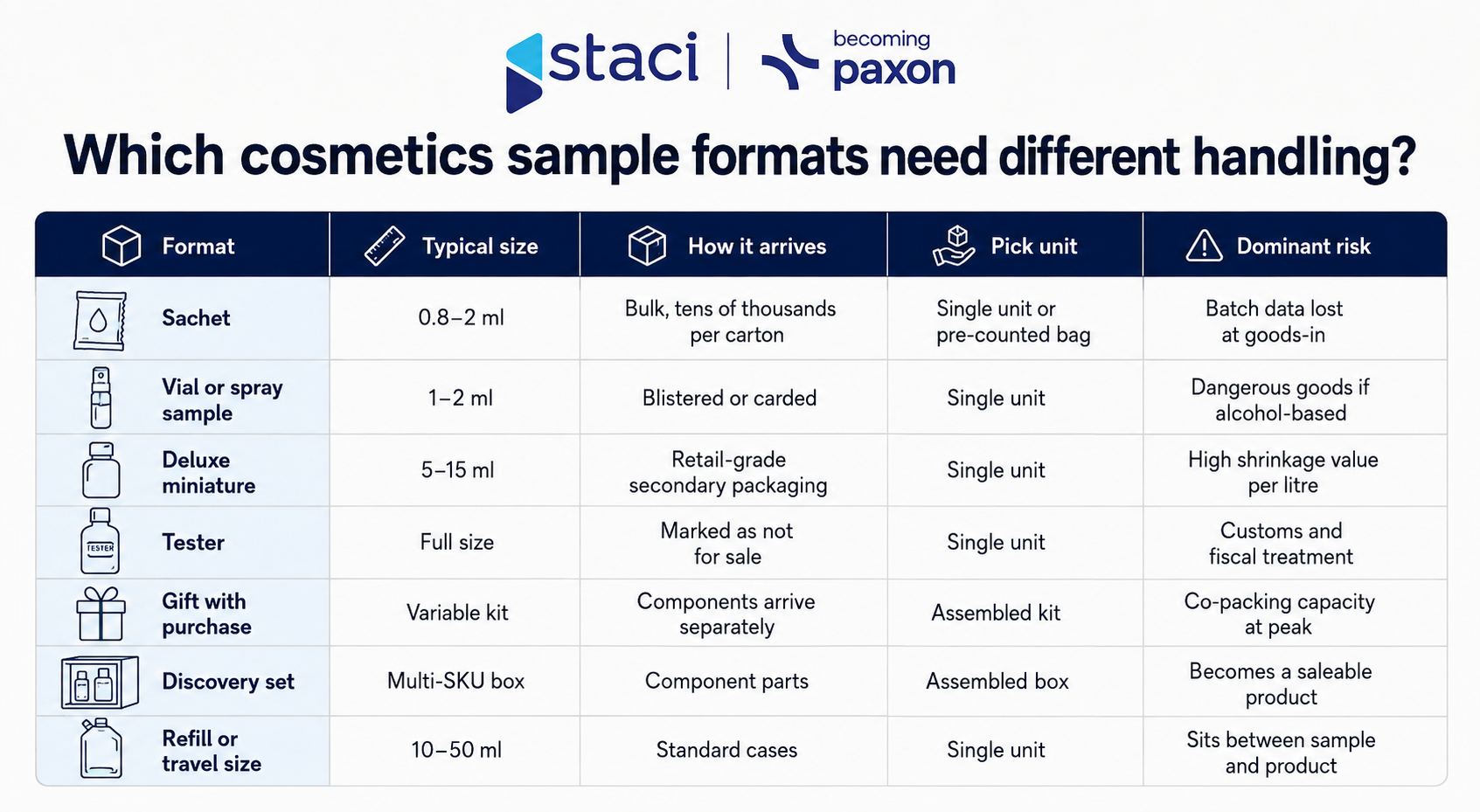
The table hides a subtlety worth stating in plain terms. The first four formats are handling problems: tiny, light, easy to miscount, easy to pocket. The last three are manufacturing problems in miniature. A gift with purchase does not arrive as a gift with purchase, it arrives as a mascara, a pouch and a printed insert, on three different purchase orders, and someone has to turn them into one unit before the campaign date.
That someone is usually the logistics operator. Which means sample fulfilment is rarely just picking. It is picking plus light assembly under campaign conditions, against a marketing deadline that was fixed before the components shipped.
Why is sampling volume growing in cosmetics?
Because sampling budgets follow category growth, and the category is growing. Spain’s cosmetics and fragrance industry reached €11,800 million in 2025, up 5.8% on the previous year, according to Stanpa’s 2025 industry review. Exports hit a record €10,124 million, keeping Spain second worldwide in perfume exports.
Two figures inside that release matter more for sampling than the headline does. The first is fragrance. Perfume grew 9.5%, passed €2,400 million and now accounts for 21% of the market, the second largest category, expanding at nearly double the market rate. Fragrance also travels badly through a product page. No swatch, no shade match, no before-and-after. Trial has to happen physically, and outside the store that means a sample.
The second is the selective channel, where perfumeries and specialist retail grew 8.9% and hold 23% of the market. That channel runs on assisted selling, and assisted selling runs on stock at the counter, a continuous replenishment problem rather than a campaign problem.
Meanwhile the point of delivery is shifting. Spanish e-commerce billed more than €114,800 million across 2025, a 20.6% annual rise, on CNMC figures. Every percentage point that moves online moves a sampling decision out of a shop assistant’s hands and into a warehouse rule. The assistant used to choose which sachet went into the bag. Now a business rule does, and a picker executes it, thousands of times a day.
What regulations apply to free cosmetic samples in the EU?
Three frameworks apply at once, and they run on different timetables.
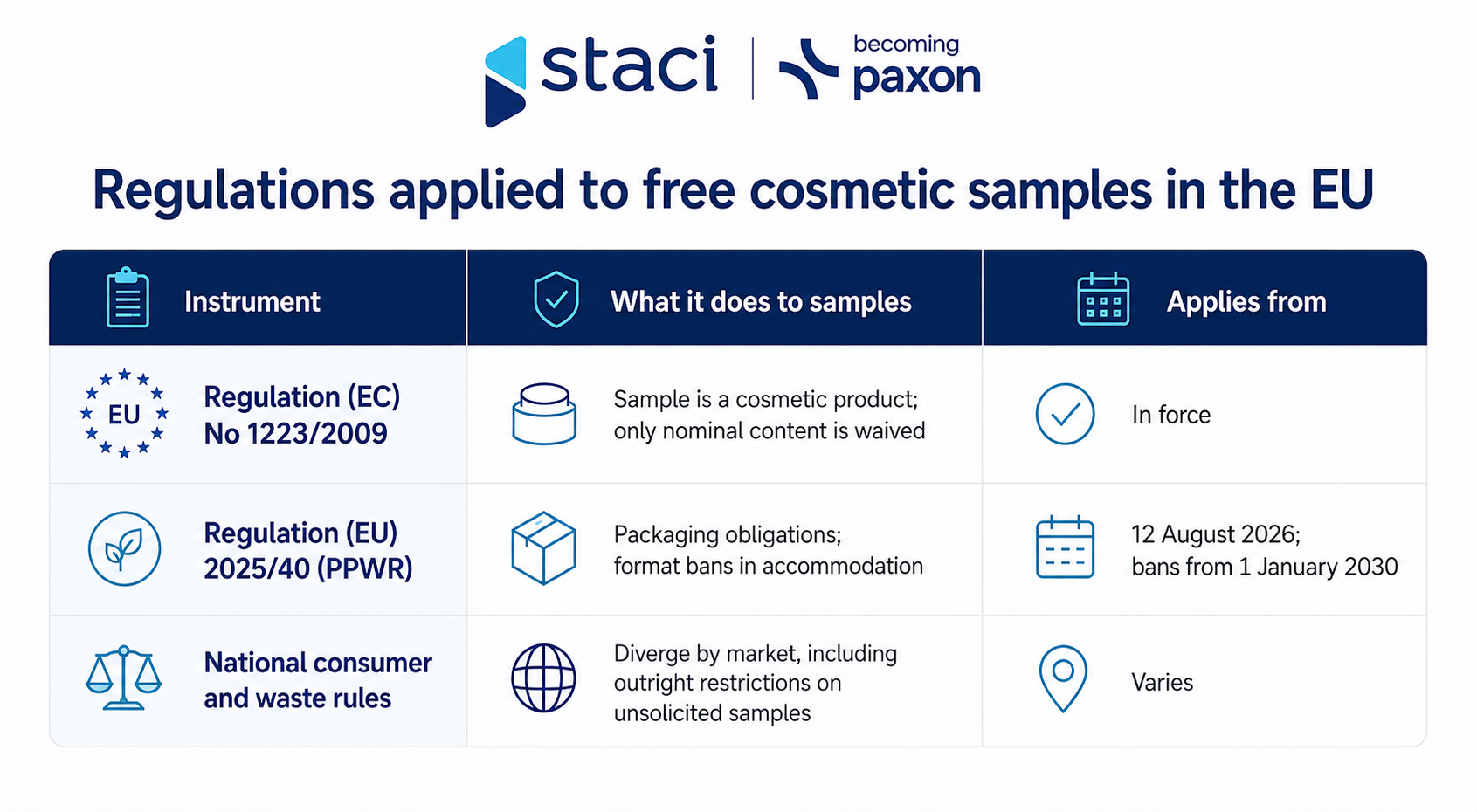
The labelling exemption is narrower than most teams assume. It covers the nominal content and nothing else, so a sachet still needs its batch reference traceable, and where the surface is too small the information moves to an attached leaflet, tag or card rather than disappearing.
Packaging obligations arrive through the Packaging and Packaging Waste Regulation, (EU) 2025/40, which entered into force on 11 February 2025 and applies from 12 August 2026. A widespread misreading is worth correcting here: the format bans in Article 25 and Annex V do not start in 2026, and they do not start in 2028 either. They start on 1 January 2030, and the beauty-relevant entry covers single-use cosmetic, hygiene and toiletry packaging supplied in accommodation. Retail sachets and counter samples are not named in Annex V.
That is the good news, and it carries a caveat. Samples are still packaging, so they still count towards extended producer responsibility reporting, still need recyclability grades and still add weight to a brand’s packaging declarations, in a format with the worst possible ratio of packaging to content. The pressure on sampling is arriving through reporting and cost, not through prohibition.
The third framework is the one that catches cross-border operations out, because it is not harmonised. France is the sharpest example: supplying a sample to a consumer who has not asked for it is prohibited under its Environment Code, with a first request in distance selling covering later deliveries until the consumer withdraws it. Read that as a data requirement rather than a marketing one.
Somewhere in the order flow there must be a consent flag, it must reach the warehouse, and the pick must honour it. An operator that cannot suppress a sample line per order, per market, cannot run a pan-European sampling programme.
Are perfume samples dangerous goods?
Usually yes. Fine fragrance is alcohol-based, alcohol is flammable, and flammability turns a 2 ml vial into freight with a UN number.
Fragrance falls under UN 1266, perfumery products with flammable solvents, Class 3, under the European Agreement concerning the International Carriage of Dangerous Goods by Road in its 2025 consolidated edition. Part 3 of the ADR sets out the dangerous goods list together with the exemptions tied to limited and excepted quantities, the mechanism that lets small consumer-sized units travel under a lighter regime, provided packaging, marking and quantity thresholds are respected. Air carriage applies a stricter framework again, through the ICAO Technical Instructions and the IATA rules built on them.
Three practical consequences follow, and none of them are visible in a marketing brief. Storage capacity is the first, because flammable stock carries segregation requirements and quantity limits per zone. A warehouse that can hold 40,000 skincare sachets in a mezzanine cannot necessarily hold 40,000 fragrance vials in the same place.
Training is the second, since everyone in the chain needs role-appropriate dangerous goods instruction and consignors above the exemption thresholds need a safety adviser.
The third catches operators out most often, and it happens at order level. A single fragrance vial dropped into an otherwise ordinary parcel can pull the entire shipment into a different transport regime, with different carrier options and different documentation. The picking rule and the shipping rule therefore have to be designed together, or the campaign that ships cleanly in October fails compliance in November.
Why is unit-level picking harder for samples?
Because the economics invert. Sample picking is the same verb as product picking and a completely different job, and the differences compound.
Pick density is the first pressure point. An order line for one sachet consumes the same scan, the same touch and the same confirmation as an order line for a €120 serum, while generating none of the revenue. Efficiency is not a margin question here; it is the entire economics of the service. This is where goods-to-person automation and carousel picking earn their place inside a warehouse built for ecommerce fulfilment, bringing the location to the operator instead of walking an operator to a bin holding items the size of a stamp.
The absence of a sale price then hides the errors. Stock booked without a value tends to escape the controls that protect priced stock, so cycle counts skip it and variances get written off without investigation. The discrepancy surfaces three weeks later, when a campaign ships short.
Batch and expiry still apply regardless. A sample with an unrecorded batch cannot be recalled selectively, so if the batch behind it is withdrawn the only safe response is to withdraw everything, exponentially more expensive than capturing a code at goods-in would have been. The same applies to storage conditions: a sample stored outside the range its formula requires fails just as quietly as one whose batch was never recorded.
Peaks are also sharper than product peaks. Product demand at Christmas rises; sampling demand at a launch goes from zero to the entire allocation in a single week, then back to zero. The staffing curve does not resemble the retail curve at all.
The sector’s own priorities point the same way. In the 2026 MHI Annual Industry Report, produced with Deloitte, 48% of supply chain leaders rated AI’s disruptive impact as significant or greater, up 25 percentage points in a year, with robotics and automation next at 39%. Adoption moved too: 41% said their organisation is now using AI, against 30% the year before.
For sample operations the useful application is unglamorous, forecasting allocation burn, catching count variances early, and sequencing kitting work so that co-packing capacity is not the thing that misses the launch date.
How does sample fulfilment change by channel?
Substantially. The same sachet behaves differently depending on where it is going, and four flows cover most of the work.
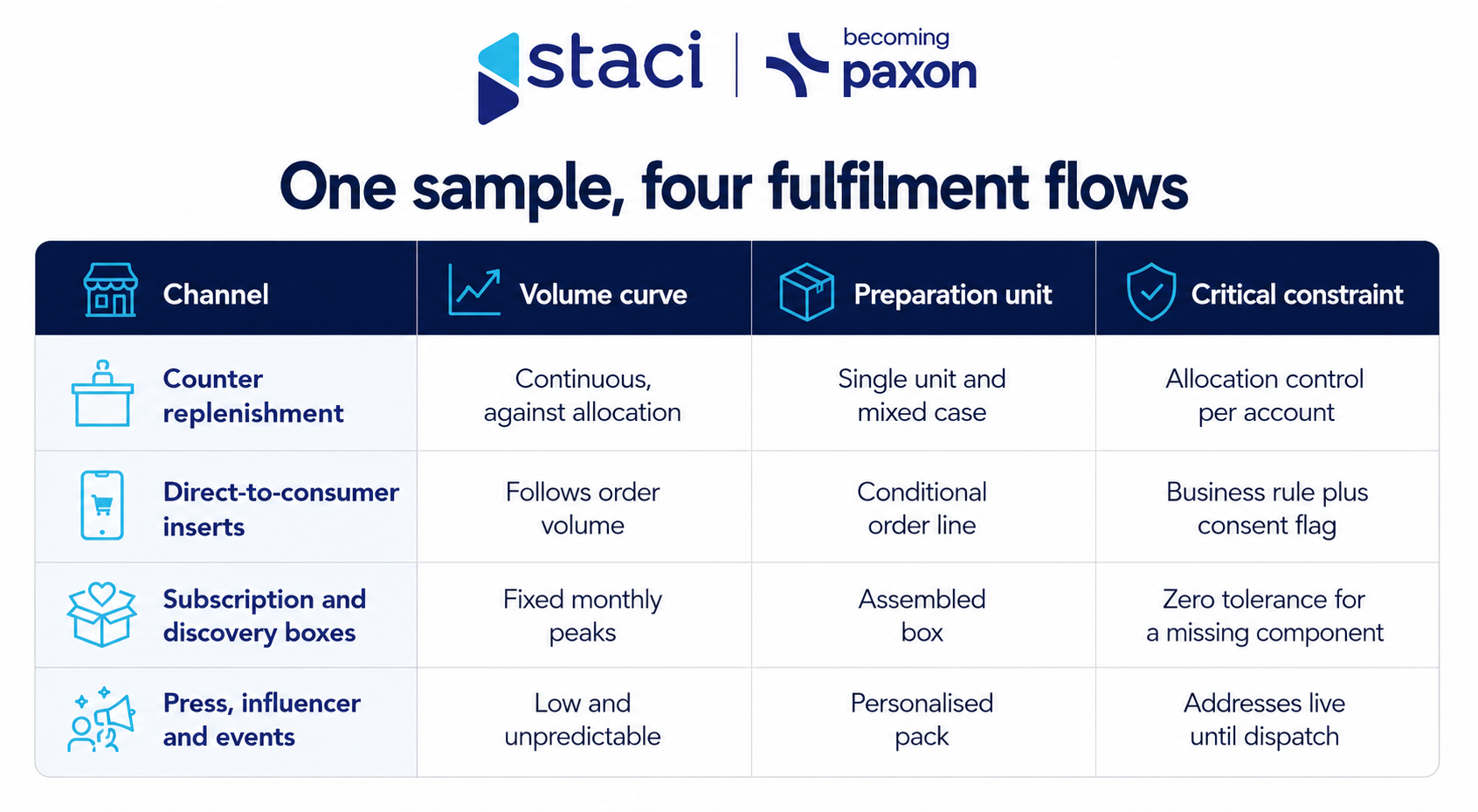
Counter replenishment looks like ordinary stock ordering and is not, because stores draw against an allocation rather than buying. The requirement is a controlled ordering channel that sets who may order, how much, how often and against which campaign budget. Without it, the largest accounts absorb the allocation in the first fortnight and the rest of the network launches empty. Where volumes justify it, cross-docking to retail removes a storage step from the cycle entirely.
Direct-to-consumer inserts move the decision into the order data, where basket value, category purchased, destination market and consent all determine whether a sample line appears. The warehouse reads those attributes and picks accordingly, at speed, without a human deciding case by case.
Subscription and discovery boxes are the point where the sample stops being an add-on and becomes the product. Volumes are high, the assembly is fixed, the date is immovable, and tolerance for a missing component is zero because every box is identical and every subscriber will notice the same gap.
Press, influencer and event seeding inverts all of that. Low volume, high visibility, non-standard packing, addresses that change until the last hour. This flow needs personalisation and courier flexibility far more than it needs throughput. An operator built around only one of these models will force the other three to fit it. That is where cost and error rates come from.
What should you ask a logistics operator for cosmetics samples?
Eight questions separate an operator that handles samples from one that merely stores them. They are worth asking before the pilot, not after.
- Can you receive and record batch and expiry data for stock that carries no purchase price?
- Can you suppress or add a sample line based on an attribute in the order, per market?
- What is your dangerous goods capability for alcohol-based fragrance, by road and by air?
- Where does co-packing happen, and what is your assembly capacity in a launch week?
- How do you control allocation across stores or sales representatives, and who can see the balance?
- What is your pick accuracy on single-unit lines, measured separately from full-product lines?
- How is sample stock counted, and how are variances escalated rather than written off?
- Can we see consumption by campaign, by market and by requester, without asking you for a report?
That last question is usually the one that decides it. Sampling fails on visibility more often than on execution: the allocation is spent, nobody knows by whom, and the launch in the next market starts short.
Staci, now part of the pan-European Paxon network, runs this flow from its logistics network in Spain, with more than 42,000 sqm dedicated to customer operations and unit-level picking combined with promotional and co-packing capability in the same buildings.
The ordering and visibility layer is Ecats Staci, the group’s own platform, which lets brands hand controlled ordering to their retail network or sales force while keeping stock, allocation and traceability in a single environment. The point is that the marketing view and the warehouse view finally read from the same number.
How Staci approaches the smallest unit in beauty
The sample is the cheapest item a beauty brand ships and the one carrying the most rules per gram. It is a cosmetic product under EU law, packaging under the PPWR, dangerous goods when it contains alcohol, and a consent-dependent delivery in several markets. It is also, quite often, the first physical contact a customer has with the brand.
Treating it as leftover stock is the expensive option. Treating it as its own flow, with its own picking model, its own compliance path and its own visibility, is what turns a marketing budget into a measurable acquisition channel.
If you are reviewing how your samples are stored, assembled and delivered across Europe, talk to the Staci team in Spain about designing that flow properly.
Cosmetics sample fulfilment: frequently asked questions
Are cosmetic samples banned in the European Union?
No. There is no EU-wide ban on cosmetic samples. Regulation (EU) 2025/40 prohibits certain single-use packaging formats from 1 January 2030, and the beauty-relevant entry concerns cosmetic and toiletry packaging supplied in accommodation. Retail samples and sachets are not listed in Annex V.
Do cosmetic samples need to be labelled?
Yes. A free sample is a cosmetic product under Regulation (EC) No 1223/2009. The only concession is that nominal content need not be declared. Responsible Person, batch identification, durability or period-after-opening, ingredients and warnings all still apply, moving to an attached leaflet or tag where the surface is too small.
Do the rules on cosmetic samples differ between EU countries?
Yes. Cosmetics law is harmonised, but consumer and waste rules are not. Several markets restrict unsolicited samples, France being the clearest case, where a sample may only be supplied to a consumer who has asked for it. A sampling programme running across Europe needs market-level rules in the order flow rather than one global rule.
Are perfume samples classified as dangerous goods?
Usually yes. Alcohol-based fragrance falls under UN 1266, Class 3, in the ADR. Small consumer-sized units may travel under limited or excepted quantity provisions if packaging, marking and quantity thresholds are respected. Air transport applies stricter rules.
Why can’t standard e-commerce fulfilment handle cosmetics samples?
Because samples carry no price, and most fulfilment controls are triggered by price. Valuation, cycle counting, batch capture and variance investigation all key off the commercial transaction. Sample flows need those controls rebuilt around campaign and allocation instead.
What does unit-level picking mean for cosmetics samples?
It means the pick unit is a single sachet, vial or miniature rather than a case or a bottle. It requires dense storage, automation or carousel-assisted picking to keep cost per line viable, and accuracy measured separately from full-product picking.
Bibliography
- European Parliament and Council of the European Union. Regulation (EC) No 1223/2009 on cosmetic products. EUR-Lex.
- Council of the European Union. Regulation (EC) No 1186/2009 setting up a Community system of reliefs from customs duty. EUR-Lex.
- European Parliament and Council of the European Union. Regulation (EU) 2025/40 on packaging and packaging waste (PPWR). EUR-Lex.
- UNECE – United Nations Economic Commission for Europe. ADR 2025: European Agreement concerning the International Carriage of Dangerous Goods by Road. 2025.
- ICAO – International Civil Aviation Organization. Technical Instructions for the Safe Transport of Dangerous Goods by Air.
- IATA – International Air Transport Association. Dangerous Goods Regulations (DGR).
- STANPA – Asociación Nacional de Perfumería y Cosmética. La industria cosmética supera los 11.800 millones de euros en consumo y consolida su liderazgo exportador en un entorno de alta exigencia global. 2026. Es la fuente utilizada para los datos de mercado español, perfumería, exportaciones y canal selectivo.
- CNMC – Comisión Nacional de los Mercados y la Competencia. E-commerce statistics in Spain, 2025. Fuente de los datos sobre facturación y crecimiento del comercio electrónico utilizados en el texto.
- MHI & Deloitte. 2026 MHI Annual Industry Report. 2026. Fuente de los datos sobre inteligencia artificial, robotics and automation adoption in supply chain operations.
Staci resources
- Staci. POS, pharma and campaign materials logistics.
- Staci. Good Distribution Practice for advertising and sales campaigns.
- Staci. E-commerce warehousing and fulfilment in Spain.
- Staci. Temperature-controlled logistics.
- Staci. Cross-docking logistics in Spain.
- Staci. Ecats Staci.